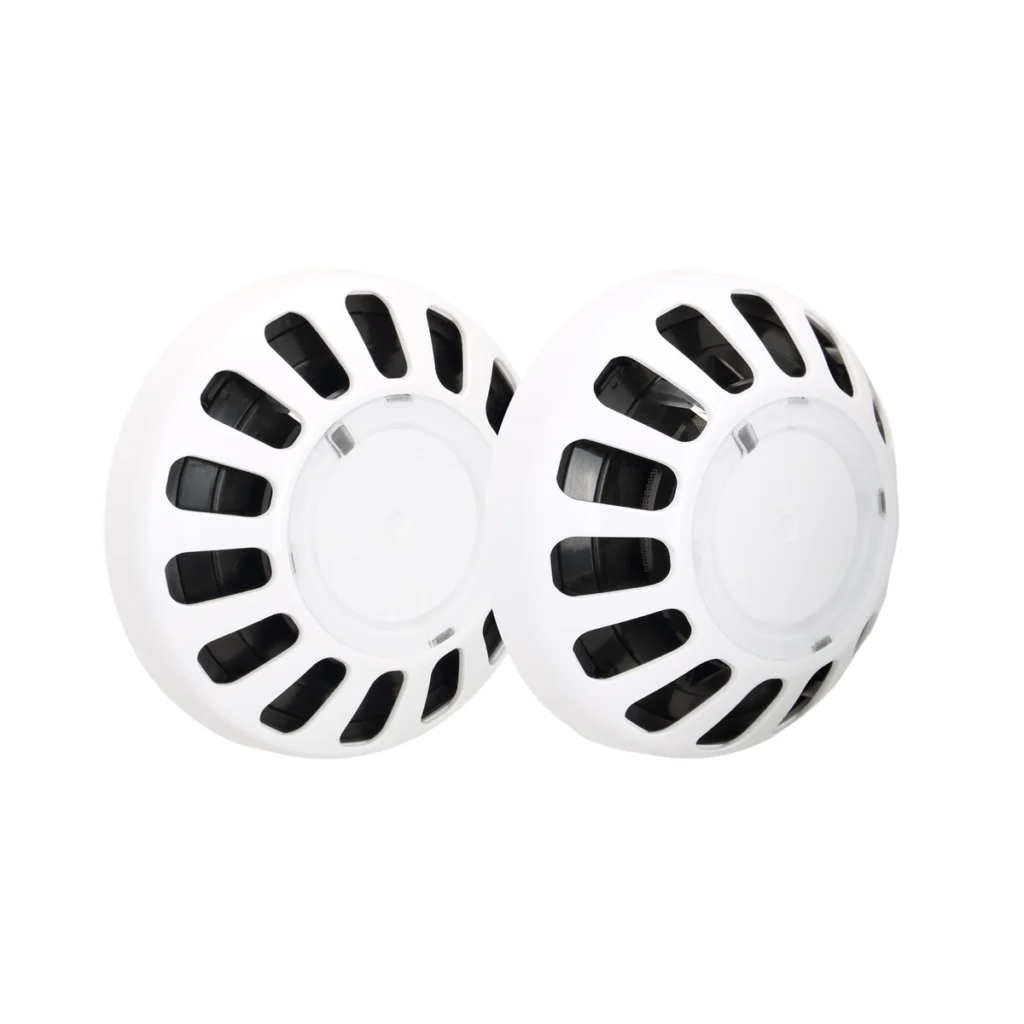
The EATON (Menvier) EFM-X830 is an intelligent soft-addressed photoelectric smoke & heat multi-criteria sensor from the Eaton UL range, listed to UL 268 7th edition and UL 521 for heat. Designed for mid to large buildings, its algorithms give high immunity to false alarms; it fits the UCAB300 base or the ULMAS850 sounder base.
In short
- Detection: photoelectric smoke & heat multi-criteria sensor (60°C / 140°F heat element, 50 ft heat-alone spacing).
- Working voltage 18 – 30 V dc, standby 235 µA, alarm 10 mA.
- Tri-colour LED viewable from 360°, drift compensation.
- Integral short-circuit isolator in every sensor.
- Order code ULEFMDOH30.
How the sensor works
The photoelectric chamber detects smoke from light scattered by particles together with a heat element; algorithms analyse more than one criterion before signalling the panel, reducing false alarms. Being addressable, the panel knows its exact location.
Each sensor has an integral short-circuit isolator that operates with the panel when a low parallel resistance (typically 200 Ω) appears on the loop, isolating the faulty section while the rest of the loop continues.
Related items
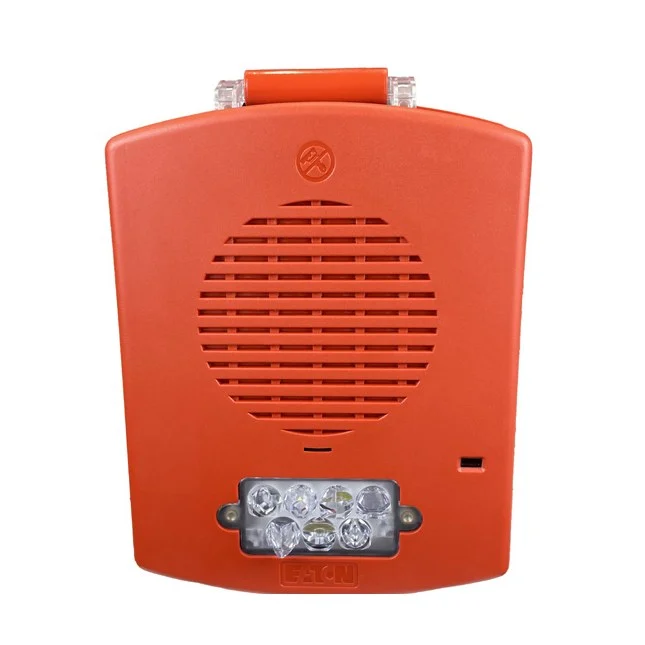
- The UCAB300 base or ULMAS850 sounder base.
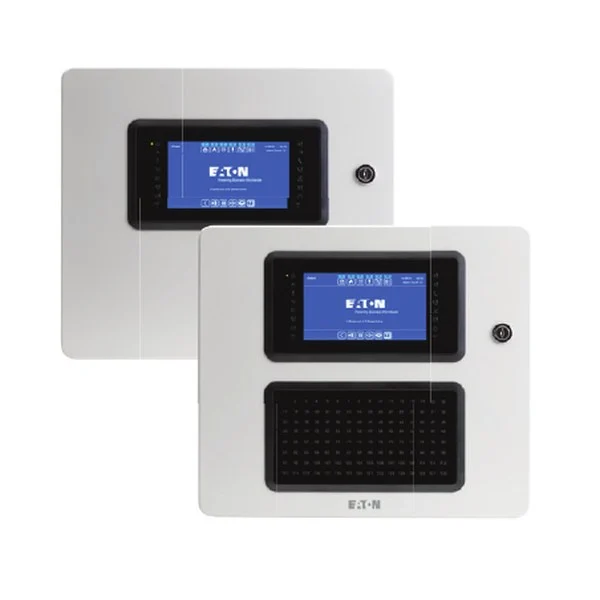
- UL listed ULDF6000 panels.
Technical data
| Item | Value |
|---|---|
| Model / order code | EFM-X830 / ULEFMDOH30 |
| Type | Photoelectric Smoke & Heat Multi-Criteria Sensor |
| Working voltage | 18 – 30 V dc |
| Standby / alarm current | 235 µA / 10 mA |
| Sensitivity | 3.16 ± 2.11 %/ft |
| Start-up / reset | 2 s / 2 s |
| UL listed ambient | 0 – 37.8 °C |
| Operating temperature | -10 – 50 °C |
| Heat element | 60 °C (140 °F) · 50 ft |
| Mounting | Ceiling and walls in open areas |
| Standard | UL 268 7th ed. · UL 521 |
| IP / colour | IP40 · RAL9003 |
The critical point: base and compatibility
The sensor is listed with the UCAB300 base or ULMAS850 sounder base and Eaton UL panels. Sensitivity testing uses a listed tester (such as No-Climb TruTest), not a flame or unlisted aerosol.
General notes on sensor layout
- Spacing: spot smoke detectors on smooth ceilings are typically laid out at a nominal 30 ft (9.1 m) per NFPA 72, and heat detectors at their listed spacing (50 ft for this range); spacing reduces for high, beamed or sloped ceilings.
- Air movement: keep smoke sensors at least 3 ft (0.9 m) from supply air diffusers, as the airflow can push smoke away from the sensor.
- Type selection: smoke for offices, rooms and corridors; smoke with heat where fast fires are expected; heat for kitchens, car parks and generator rooms with dust or fumes.
- Sensors in lift lobbies and machine rooms are typically used for elevator recall, and duct detectors for HVAC shutdown, per the governing standards.
- Periodic testing: sensors are functionally tested annually and sensitivity-tested periodically per NFPA 72 Chapter 14, with listed test tools.
General engineering notes
These points are general principles from NFPA 72 and common design practice, not from the EATON datasheet. The final decision rests with the project’s approved designer per the adopted edition of the standard and the authority having jurisdiction.
Installation steps
- Install the base and wire the loop (in and out) and earth.
- Fit the sensor to the base and turn clockwise until it locks.
- Enable the base locking feature if unauthorised removal must be prevented.
- Run auto-learn at the panel and test the sensor with the listed tester.
Common mistakes
- Do not use high-voltage insulation testers while devices or the panel are connected, as the Eaton datasheets warn.
- Installing in permanent dust or steam instead of using a heat sensor.
- Using an incompatible base.
Inspection and maintenance
Before any test or maintenance, notify the owner, the monitoring station and everyone affected, as testing may operate alarms or linked outputs. The owner is responsible for inspection, testing and maintenance per NFPA 72 and the authority having jurisdiction, preferably by a qualified company.
The LED flashes amber on self-test failure: check for a short-circuited connection or replace the sensor, per the datasheet table.
Files and ordering
The EATON datasheet (EFM-X810 / X830) and the available UL certificate are in the files section of this page. When ordering, state the model EFM-X830 (ULEFMDOH30) and the base required.
How to order
Use the “Build your order” section on this page: add every model and quantity, then send the whole order by email or WhatsApp. It reaches us as a tidy PDF request sheet and we contact you with the quotation.
FAQ
EFM-X810 vs EFM-X830?
X810 is a multi-criteria smoke sensor; X830 adds a 60°C heat element with UL 521.
Does it need manual addressing?
No, addressing is done by software from the panel.
What is drift compensation?
It compensates for chamber contamination over time so sensitivity stays stable.
References
- EATON EFM-X — Datasheet (attached)
- UL 268 — Smoke Detectors for Fire Alarm Systems
- UL 521 — Heat Detectors for Fire Protective Signaling Systems
- NFPA 72 — National Fire Alarm and Signaling Code
This page is general information to help with selection and ordering, taken from the attached EATON datasheet. Final design is set by the project’s approved designer; the project specification, the consultant’s drawings and the latest datasheet revision govern.