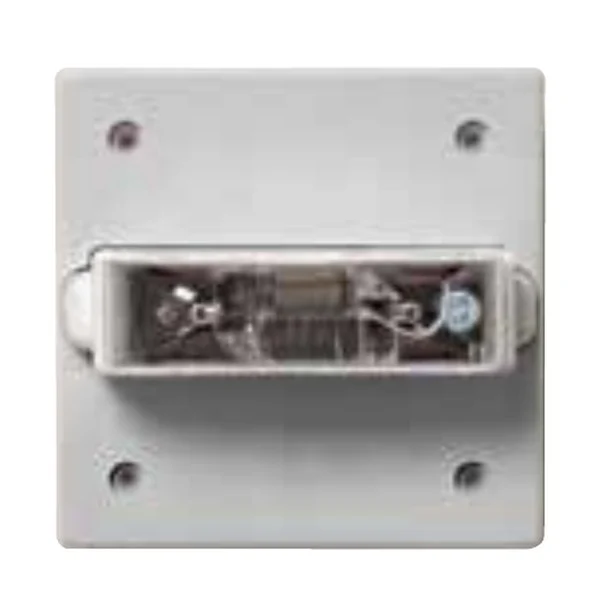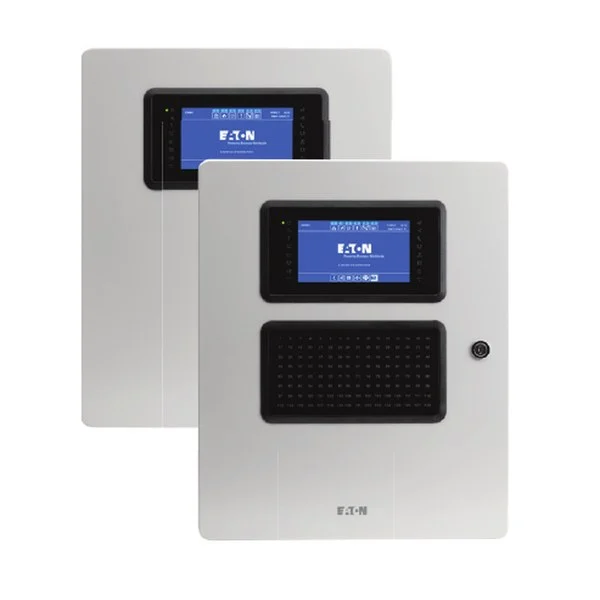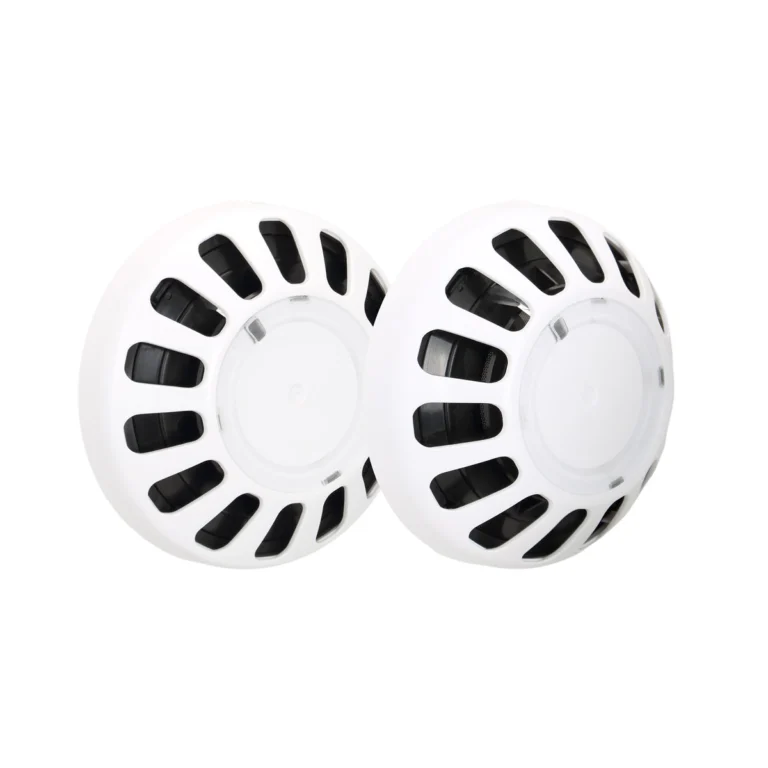
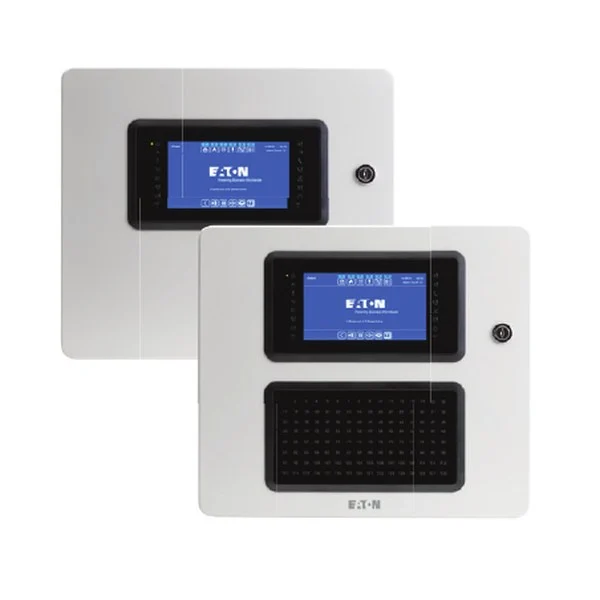
The EATON EFXD01020 is an xDetect addressable fire alarm panel (2 loop) with a tablet-like 7″ colour touchscreen that changes colour with system status. It is secure-by-design for BMS and IoT connectivity, and certified to EN54-2 and EN54-4, LPCB 378q/01.
In short
- Small (7 card frame) enclosure, up to 2 loops and 400 addresses.
- 600 mA maximum per loop, loop length up to 2 km.
- Modular colour-coded card system with redundancy, matrix cause & effect programming with xDetectWorks.
- Fault-tolerant ring network with built-in isolators, so no redundant network is needed.
- Approvals: EN54-2, EN54-4, LPCB 378q/01.
How the xDetect panel works
The panel is built on modular cards: a gateway card and a loop card come pre-fitted, and further loop, sounder, I/O or network cards are added as the project needs, so the panel grows with the building. Each card has local status LEDs for easy maintenance.
The datasheet notes the first release (MR1.0) supports networks of up to 20 panels and MR1.1 up to 126 panels; Eaton technical support advises further.
Models in the datasheet
| Model | Description |
|---|---|
| EFXD01020 — this model | Small, 2 loop |
| EFXD01022 | Small, 2 loop, 128 ZI |
| EFXD01040 | Large, 4 loop |
| EFXD01042 | Large, 4 loop, 128 ZI |
Links to the other models are in the “Similar models” table below.
Related items
- xDetect cards: loop EFXD05001, sounder EFXD05020, I/O EFXD05030, network EFXD05040, and the 150 W power supply EFXD05051.
- Panel doors and zonal indicator boards (EFXD05091 – EFXD05095).
Technical data
| Item | Value |
|---|---|
| Enclosure | Small |
| Loops | 1 – 2 |
| Zonal indicator | — |
| Max. zones | 256 |
| Mains | 230 V ac +10% −15%, 50/60 Hz |
| Batteries | 2 × 12 V 12 Ah (not included) |
| Standby | up to 24 h |
| Dimensions | 374 × 426 × 148 mm |
| Weight (no batteries) | 8.4 kg |
| Operating temperature | -5 to +50 °C, 95% RH |
| Approvals | EN54-2 · EN54-4 · LPCB 378q/01 |
The critical point: cards and power
The number of alarm devices is set by loop cards, sounder cards and power supplies: up to 131 per loop card, 106 per sounder card, and up to 262 per panel with one PSU. Load calculation decides the cards needed.
General design notes for the panel
- Class A vs Class B: in Class A the loop returns to the panel at both ends, so devices keep working through a single open. In Class B the circuit ends at the last device, so everything after a break is lost. This panel’s loops are Class A Style 7, and with short-circuit isolators only the faulty section is isolated.
- Batteries: NFPA 72 typically requires 24 hours of standby followed by 5 minutes of alarm. Add up standby and alarm current for all devices, apply the derating factor in the datasheet (0.1 for ULDF6000), and check the result is within the panel’s capacity.
- Panel location: usually near the entrance used by the fire department or in a continuously attended control room, as agreed with the authority.
- Cause & effect is documented in an approved matrix before commissioning (which input operates which output), and every line is tested at acceptance.
- Acceptance: test every device individually, and hand over as-built drawings and a record of completion per NFPA 72 and the authority.
General engineering notes
These points are general principles from NFPA 72 and common design practice, not from the EATON datasheet. The final decision rests with the project’s approved designer per the adopted edition of the standard and the authority having jurisdiction.
Installation steps
- Mount the enclosure and use the specified cable entries (top, sides and bottom).
- Fit additional cards by colour code and slot.
- Connect mains, batteries, loops and the ring network.
- Program cause & effect with xDetectWorks and test the system.
Common mistakes
- Not calculating loop cards and power for the actual number of alarm devices.
- Using incompatible peripherals; the current list is on the Eaton website.
- Do not use high-voltage insulation testers while devices or the panel are connected, as the Eaton datasheets warn.
Inspection and maintenance
Before any test or maintenance, notify the owner, the monitoring station and everyone affected, as testing may operate alarms or linked outputs. The owner is responsible for inspection, testing and maintenance per NFPA 72 and the authority having jurisdiction, preferably by a qualified company.
Card status LEDs make faults easy to locate; the system is inspected per the project standard.
Files and ordering
The EATON xDetect datasheet is in the files section. When ordering, state the model EFXD01020 and any additional cards and doors.
How to order
Use the “Build your order” section on this page: add every model and quantity, then send the whole order by email or WhatsApp. It reaches us as a tidy PDF request sheet and we contact you with the quotation.
FAQ
Is xDetect UL listed?
No, the datasheet lists EN54-2 / EN54-4 and LPCB. For projects requiring UL, use the ULDF6000 panels.
What is the cybersecurity benefit?
The panel is designed to protect data and communications, so it is safe to connect to BMS and IoT.
Can it be expanded later?
Yes, by adding loop, sounder, I/O or network cards within the card frame.
References
- EATON xDetect — Datasheet (attached)
- EN 54-2 / EN 54-4 — Control and indicating equipment, and power supply equipment
This page is general information to help with selection and ordering, taken from the attached EATON datasheet. Final design is set by the project’s approved designer; the project specification, the consultant’s drawings and the latest datasheet revision govern.