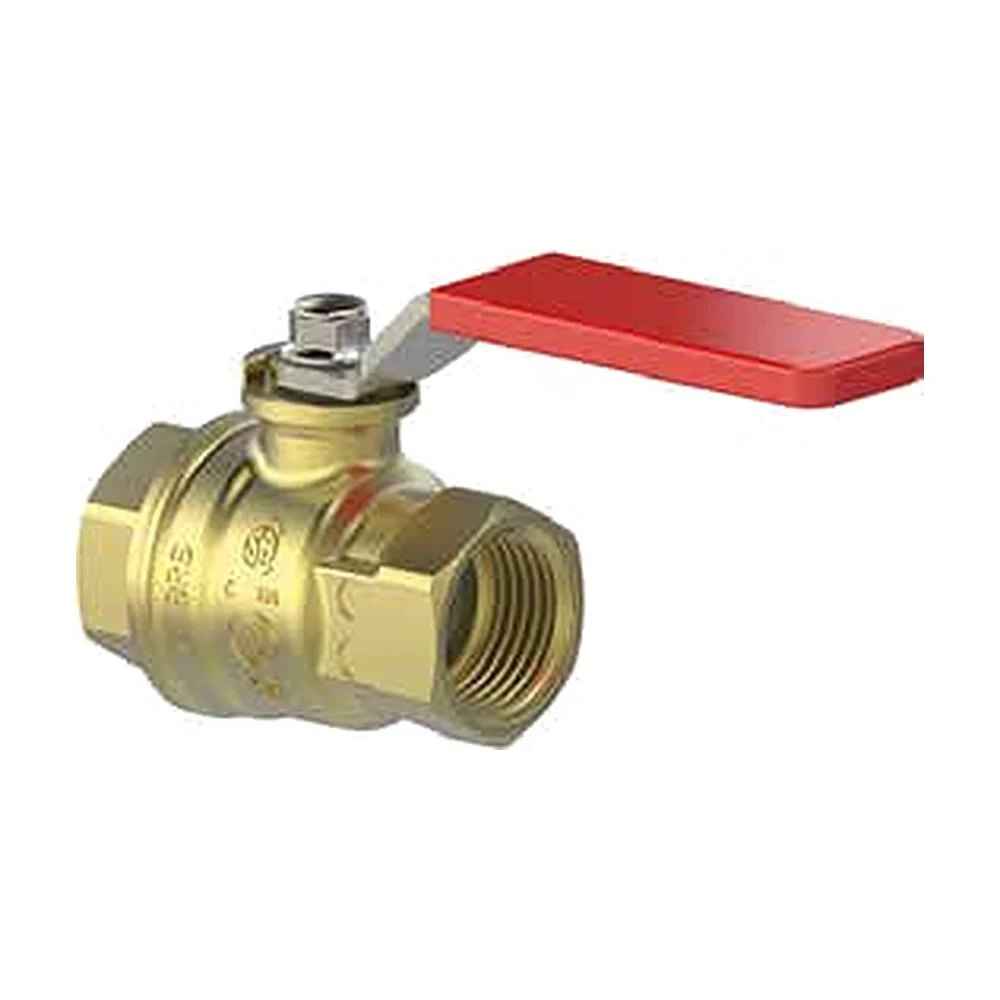
The GIACOMINI R910 is a full port isolation ball valve for fire protection systems, with a forged brass body, chrome plated ball and PTFE seats, and female NPT inlet and outlet. Full port means the ball bore is about the same as the pipe bore, so pressure loss is low. See the guide to types of fire fighting valves.
In short
- Sizes from 1/2″ to 4″.
- Rated pressure 400 / 600 psi per the catalogue.
- Forged brass body, chrome plated ball, PTFE seats.
- Sizes 1/2″ to 2″: FM Approved and cULus Listed (175 psi in the catalogue).
- Attached FM approval: quick opening valve, 1/2″ to 2″, 600 psi.
Where it is used
A quarter turn of the lever opens or closes the valve. It isolates small lines in the fire system such as drain and test lines, gauge feeds and small branches.
Valves controlling the sprinkler water supply must be indicating and supervised per NFPA 13. A quarter-turn ball valve is used where the standard and project design allow.
Technical data
| Item | Value |
|---|---|
| Model | R910 |
| Rated pressure | 400 / 600 psi |
| Body | Forged brass, chrome plated ball, PTFE seats |
| Connection | Female × female NPT |
| 1/2″ | Port 19/32″ · A 2-7/32″ · B 1-7/16″ · C 3-3/64″ · D 2-5/64″ · H 63/64″ |
| 3/4″ | Port 51/64″ · A 2-15/32″ · B 1-29/32″ · C 3-3/4″ · D 2-23/32″ · H 1-7/32″ |
| 1″ | Port 63/64″ · A 3″ · B 2-1/16″ · C 3-3/4″ · D 3-1/32″ · H 1-9/16″ |
| 1-1/4″ | Port 1-17/64″ · A 3-13/32″ · B 2-1/4″ · C 3-3/4″ · D 3-13/32″ · H 1-55/64″ |
| 1-1/2″ | Port 1-37/64″ · A 3-51/64″ · B 2-49/64″ · C 5-3/8″ · D 4-15/64″ · H 2-1/8″ |
| 2″ | Port 1-31/32″ · A 4-23/64″ · B 3-5/64″ · C 5-3/8″ · D 4-55/64″ · H 2-5/8″ |
| 2-1/2″ | Port 2-1/2″ · A 6-1/64″ · B 4-23/64″ · C 7-11/32″ · D 6-21/32″ · H 3-15/64″ |
| 3″ | Port 3″ · A 6-13/16″ · B 7-31/64″ · C 7-11/32″ · D 7-13/32″ · H 3-25/32″ |
| 4″ | Port 4″ · A 8-17/32″ · B 6-1/64″ · C 10-7/64″ · D 9-31/64″ · H 4-31/32″ |
| Approvals | FM (1140) for 1/2″ to 2″ at 600 psi, and cULus for the same sizes at 175 psi per the catalogue. Sizes 2-1/2″ to 4″ show no approval mark. |
The critical point: approvals only up to 2″
The FM and cULus marks in the catalogue cover 1/2″ to 2″ only. Where the project requires an approved valve in a larger size, choose another type.
A ball valve closes quickly; close it slowly to avoid water hammer.
Installation steps
- Clean the pipe thread and apply sealant to the male thread only.
- Tighten with a wrench on the hexagon nearest the pipe, not across the body from the far end.
- Leave room for the lever’s quarter turn.
- Pressure test for tightness and operate to check movement.
Common mistakes
- Wrenching across the body from the far end, twisting it and causing leaks.
- Using it as a main sprinkler control valve without indication and supervision.
- Fast closure causing water hammer.
- Leaving it half open to throttle, eroding the seat.
Inspection and maintenance
Operate the valve periodically (open and close) so it does not seize, and check for leaks at the stem and joints.
Inspection, testing and maintenance are the owner’s responsibility per NFPA 25 and the authority having jurisdiction, preferably by a qualified company. Notify the owner, the monitoring station and everyone affected before any test.
Files and ordering
The GIACOMINI catalogue page for the R910 and the FM approval are in the files section of this page. When ordering, state the size and finish (brass or chrome).
How to order
Use the “Build your order” section on this page: add every model and quantity, then send the whole order by email or WhatsApp. It reaches us as a tidy PDF request sheet and we contact you with the quotation.
FAQ
What does full port mean?
The ball bore is about the pipe bore, so the waterway is not reduced.
Are all sizes approved?
No, only 1/2″ to 2″ per the catalogue and the FM approval.
References
- GIACOMINI R910 — Datasheet (attached)
- NFPA 13 — Standard for the Installation of Sprinkler Systems
- NFPA 25 — Inspection, Testing and Maintenance of Water-Based Fire Protection Systems
This page is general information to help with selection and ordering, taken from the attached GIACOMINI datasheet. Final design is set by the project’s approved designer; the project specification, the consultant’s drawings and the latest datasheet revision govern.