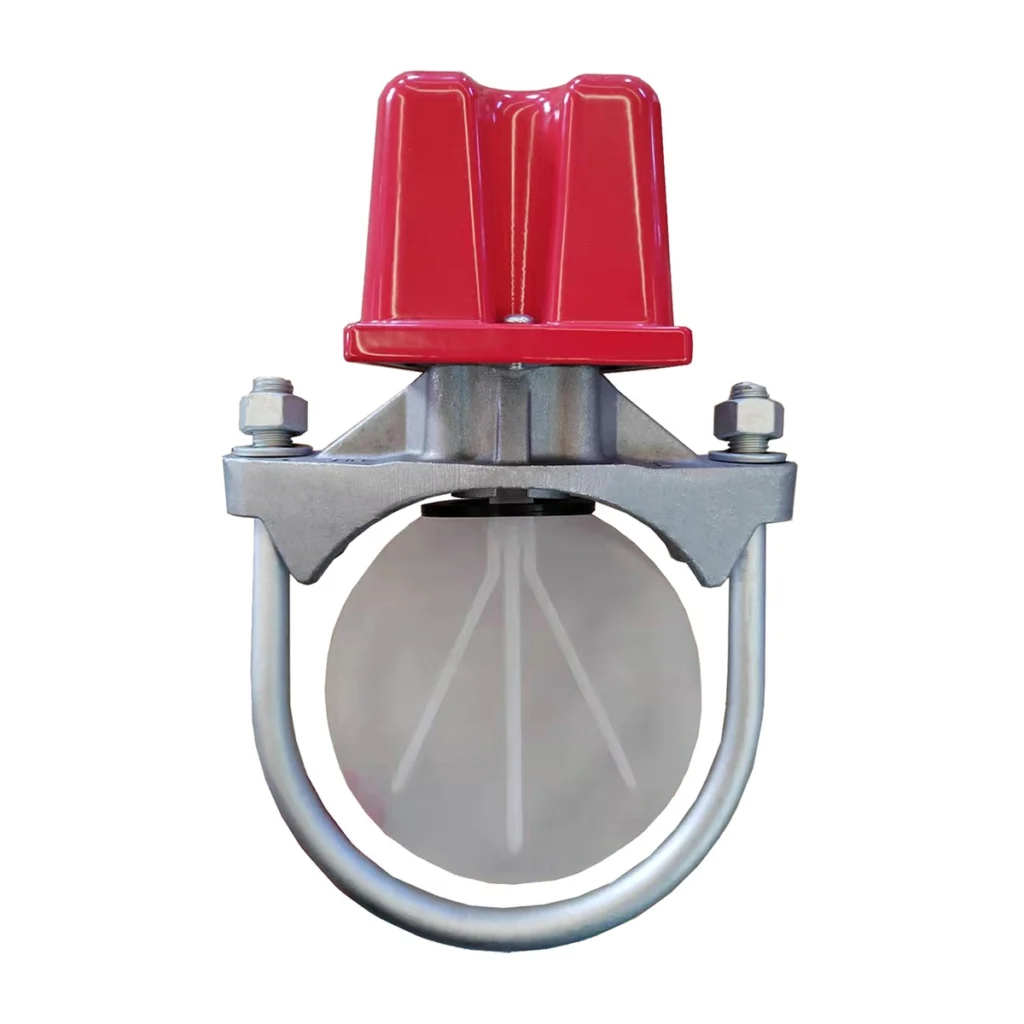
The TYCO Model TF detects waterflow in a wet sprinkler system. It has SPDT contacts and an adjustable pneumatic vane retard, and operates when flow above its sensitivity lasts longer than the retard setting. Available for APAC and EMEA. See the guide to types of fire fighting valves.
In short
- Saddle mount for 2″ – 10″ pipe, or NPT thread mount for 1″ – 2″.
- Adjustable retard 0 – 90 seconds; an immediate-activation thread-mount model is also available.
- Signal sensitivity 4 – 10 gpm (15 – 37 L/min); max. service pressure 450 psi (300 psi for TF-100, -EX and -T).
- Standard model for non-hazardous locations; explosion-proof (-EX) for hazardous locations, saddle mount only.
- Cover with a tamper-resistant screw needing the supplied special key.
How the waterflow switch works
Flow in the pipe deflects the vane and starts the pneumatic retard. If flow lasts longer than the retard, the contacts transfer and signal the panel. If flow stops before the retard elapses, the timer resets.
The retard prevents false alarms from brief pressure surges.
Technical data
| Item | Value |
|---|---|
| Mounting | Saddle 2″ – 10″, thread 1″ – 2″ |
| Retard | 0 – 90 s |
| Flow sensitivity | 4 – 10 gpm (15 – 37 L/min) |
| Max. service pressure | 450 psi (31 bar); 300 psi TF-100 / -EX / -T |
| Contact ratings | 8 A 125/250 VAC · 3 A 24 VDC · 2.5 A 30 VDC |
| Operating temperature | 0 – 49 °C |
The critical point: switch location
Do not install within 6 in. (15 cm) of a fitting that changes flow direction or within 24 in. (60 cm) of a valve or drain. In horizontal runs, install on top of the pipe.
Installation steps
- Choose a location meeting the minimum distances from fittings, valves and drains.
- Install vertically or horizontally; on horizontal runs on top of the pipe.
- Set the retard per the authority’s requirements.
- Wire the contacts to the panel and test by opening the inspector’s test connection.
Common mistakes
- Installing too close to an elbow or valve, giving unstable signals.
- Using a standard model in a hazardous location instead of the -EX.
- Setting a retard longer than allowed.
Inspection and maintenance
Before closing a main control valve for maintenance, obtain permission from the proper authorities and notify everyone affected. The owner is responsible for inspection, testing and maintenance to NFPA 25 and the authority having jurisdiction; any impairment must be corrected immediately.
Test the switch periodically by opening the inspector’s test connection and confirming the signal arrives within the required time.
Files and ordering
TYCO datasheet TFP2111 and the available approval certificates are in the files section of this page. When ordering, state the mounting (saddle or thread), pipe size, and standard or explosion-proof model. The datasheet lists the part numbers (P/N).
How to order
Use the “Build your order” section on this page: add every model and quantity, then send the whole order by email or WhatsApp. It reaches us as a tidy PDF request sheet and we contact you with the quotation.
FAQ
Why is there a retard?
To prevent false alarms from brief surges; the switch only operates if flow lasts longer than the retard.
Does it work on dry systems?
No, the datasheet specifies it for detecting flow in wet systems.
Where is the -EX used?
In hazardous locations, saddle mount only.
References
- TYCO TFP2111 — Datasheet (attached)
- NFPA 25 — Inspection, Testing and Maintenance of Water-Based Fire Protection Systems
This page is general information to help with selection and ordering, taken from the attached TYCO datasheet. Final design is set by the project’s approved designer; the project specification, the consultant’s drawings and the latest datasheet revision govern.