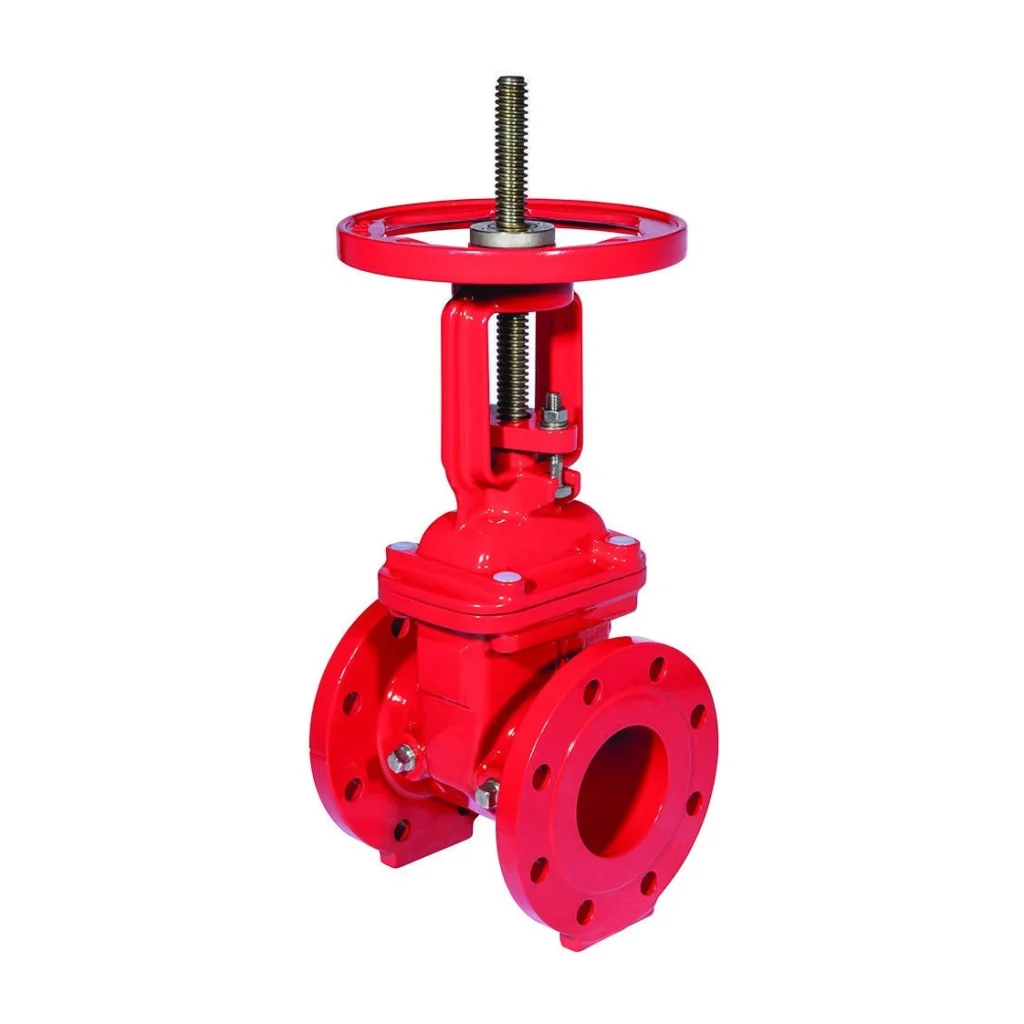
The TYCO TJR is a resilient-seated OS&Y (outside screw and yoke) gate valve for on/off service in fire protection systems. Its ductile iron body weighs about 50% less than conventional cast iron valves, and its fully EPDM-encapsulated ductile iron wedge gives bubble-tight sealing. See the guide to types of fire fighting valves.
In short
- Sizes: 2″ – 16″ (DN50 – DN400).
- Max. 300 psi (20.7 bar) up to 12″, 250 psi (17.2 bar) for 14″ and 16″.
- Flange × flange, flange × groove or groove × groove, with two plugged tapping bosses.
- Flange drilling: ANSI 150, PN10 / PN16 or AS 2129 Table E.
- Approvals: UL, ULC and FM.
How an OS&Y valve works
Turning the handwheel moves the threaded stem out or in, raising or lowering the wedge. The exposed stem shows the valve position at a glance: stem out means open.
Components are corrosion-resistant or fusion-bonded epoxy coated for long life and UV protection outdoors. The tapping bosses up- and downstream of the wedge take valve trim.
Related items
- The TOSY supervisory switch to monitor the open position electrically (TFP2113).
Technical data
| Item | Value |
|---|---|
| Type | Resilient-seated OS&Y gate |
| Sizes | 2″ – 16″ (DN50 – DN400) |
| Max. pressure | 300 psi (2″ – 12″) · 250 psi (14″ – 16″) |
| End connections | F × F, F × G, G × G |
| Flanges | ASME B16.1 / B16.42 · EN 1092-2 / ISO 7005-2 |
| Tapping bosses | 1/2″ NPT (2″ – 6″), 3/4″ (8″), 1″ (10″ – 16″) |
| Approvals | UL · ULC · FM |
The critical point: accessibility
The datasheet recommends locating gate valves where operation, inspection and maintenance are readily accessible. A control valve that is hard to reach delays isolation and inspection.
Installation steps
- Choose a location readily accessible for operation, inspection and maintenance.
- Confirm flange drilling or grooves match the mating pipe and fittings.
- Tighten bolts in a cross pattern, or fit the grooved coupling per its manufacturer.
- Fit the supervisory switch where the valve is supervised.
Common mistakes
- Installing the valve high up or enclosed where it is hard to reach.
- Mixing flange drilling standards between valve and piping.
- Leaving a control valve unsupervised where the authority requires supervision.
Inspection and maintenance
Before closing a main control valve for maintenance, obtain permission from the proper authorities and notify everyone affected. The owner is responsible for inspection, testing and maintenance to NFPA 25 and the authority having jurisdiction; any impairment must be corrected immediately.
Control valves are operated and inspected periodically per NFPA 25 to confirm they are fully open and move freely.
Files and ordering
TYCO datasheet TFP1541 and the available approval certificates are in the files section of this page. When ordering, state the size, end connections and flange drilling standard. The datasheet lists the part numbers (P/N).
How to order
Use the “Build your order” section on this page: add every model and quantity, then send the whole order by email or WhatsApp. It reaches us as a tidy PDF request sheet and we contact you with the quotation.
FAQ
What is the difference between OS&Y and NRS?
In OS&Y the stem rises and shows the position; in NRS it does not. For detail see OS&Y vs NRS gate valve.
What does the resilient seat give?
An EPDM-encapsulated wedge gives bubble-tight sealing without a bottom cavity where debris collects.
Is it suitable outdoors?
Yes, components are corrosion-resistant or fusion-bonded epoxy coated with UV protection, per the datasheet.
References
- TYCO TFP1541 — Datasheet (attached)
- NFPA 25 — Inspection, Testing and Maintenance of Water-Based Fire Protection Systems
This page is general information to help with selection and ordering, taken from the attached TYCO datasheet. Final design is set by the project’s approved designer; the project specification, the consultant’s drawings and the latest datasheet revision govern.