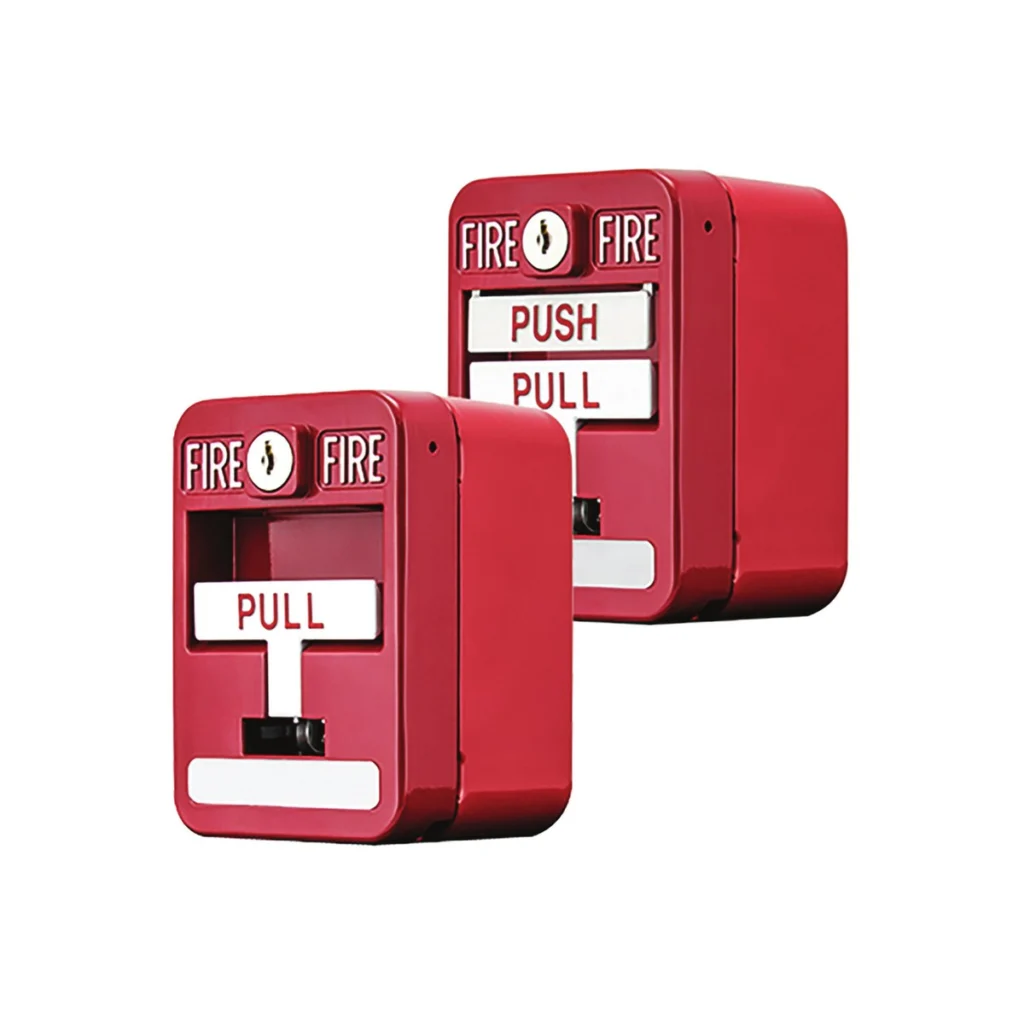
The EATON EFM-APS200WP is a addressable dual action, weatherproof fire alarm pull station from the Eaton UL range, in red die-cast metal with raised white lettering. It comes with the ULMCIM-C fast-response input module, so no hard addressing is needed.
In short
- Dual Action, Weatherproof: the push bar rotates inward and the handle is pulled in one motion.
- Key reset; corrosion-resistant gold-plated SPST contacts.
- The handle locks after pulling and is visible from 50 ft.
- NEMA 3R weatherproof for outdoor use.
How the pull station works
Pulling the white handle fully down locks it in place and the module signals the panel with its own address. Reset by opening the station with the key, returning the handle upright and relocking.
Models in the datasheet
| Model | Description |
|---|---|
| EFM-APS100 | Addressable — Single Action |
| EFM-APS100WP | Addressable — Single Action, Weatherproof |
| EFM-APS200 | Addressable — Dual Action |
| EFM-APS200WP — this model | Addressable — Dual Action, Weatherproof |
| SG42BK2 | Conventional — Conventional Single Action |
| SG42BK1 | Conventional — Conventional Dual Action |
Links to the other models are in the “Similar models” table below.
Technical data
| Item | Value |
|---|---|
| Model | EFM-APS200WP |
| Type | Addressable — Dual Action, Weatherproof |
| Construction | Red die-cast metal |
| Dimensions | 118 × 80 × 80 mm |
| Rating | NEMA 3R |
| SLC | Class A, Style 7 |
| Approval | UL listed |
The critical point: correct wiring
Field wiring connects to the clamping terminals on the ULMCIM-C, not wrapped around terminal screws, and the module is programmed as a pull station in Site Installer.
General notes on pull stations
- Location: a pull station within 5 ft (1.5 m) of each exit door on every floor, per NFPA 72.
- Height: the operable part between 42 and 48 in (1.07 – 1.22 m) above the floor.
- Travel distance: no more than 200 ft (61 m) to the nearest station on a floor.
- Where tampering is likely, listed protective covers are added; outdoor stations use weatherproof models.
General engineering notes
These points are general principles from NFPA 72 and common design practice, not from the EATON datasheet. The final decision rests with the project’s approved designer per the adopted edition of the standard and the authority having jurisdiction.
Installation steps
- Fit the box: a single-gang box for flush, or SGB32S / SGWP for surface (four 0.187″ holes).
- Open the station with the key and fix the mounting plate to the box with the supplied screws.
- Wire per the wiring diagram and check the handle is in standby before locking.
- Test the alarm, then reset with the key.
Common mistakes
- Wrapping wires around terminal screws instead of the clamping terminals.
- Installing an indoor station outdoors instead of a WP model.
- Do not use high-voltage insulation testers while devices or the panel are connected, as the Eaton datasheets warn.
Inspection and maintenance
Before any test or maintenance, notify the owner, the monitoring station and everyone affected, as testing may operate alarms or linked outputs. The owner is responsible for inspection, testing and maintenance per NFPA 72 and the authority having jurisdiction, preferably by a qualified company.
Files and ordering
The EATON datasheet (APS) and the available UL certificate are in the files section of this page. When ordering, state the model EFM-APS200WP.
How to order
Use the “Build your order” section on this page: add every model and quantity, then send the whole order by email or WhatsApp. It reaches us as a tidy PDF request sheet and we contact you with the quotation.
FAQ
Single vs dual action?
Single action is a pull only; dual action needs a push then a pull, reducing accidental operation.
Does it need addressing?
No, the ULMCIM-C is soft addressed.
References
- EATON APS — Datasheet (attached)
- NFPA 72 — National Fire Alarm and Signaling Code
This page is general information to help with selection and ordering, taken from the attached EATON datasheet. Final design is set by the project’s approved designer; the project specification, the consultant’s drawings and the latest datasheet revision govern.