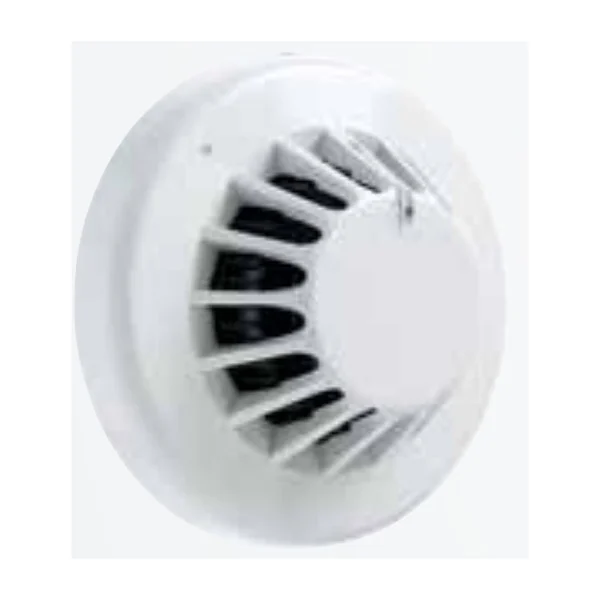
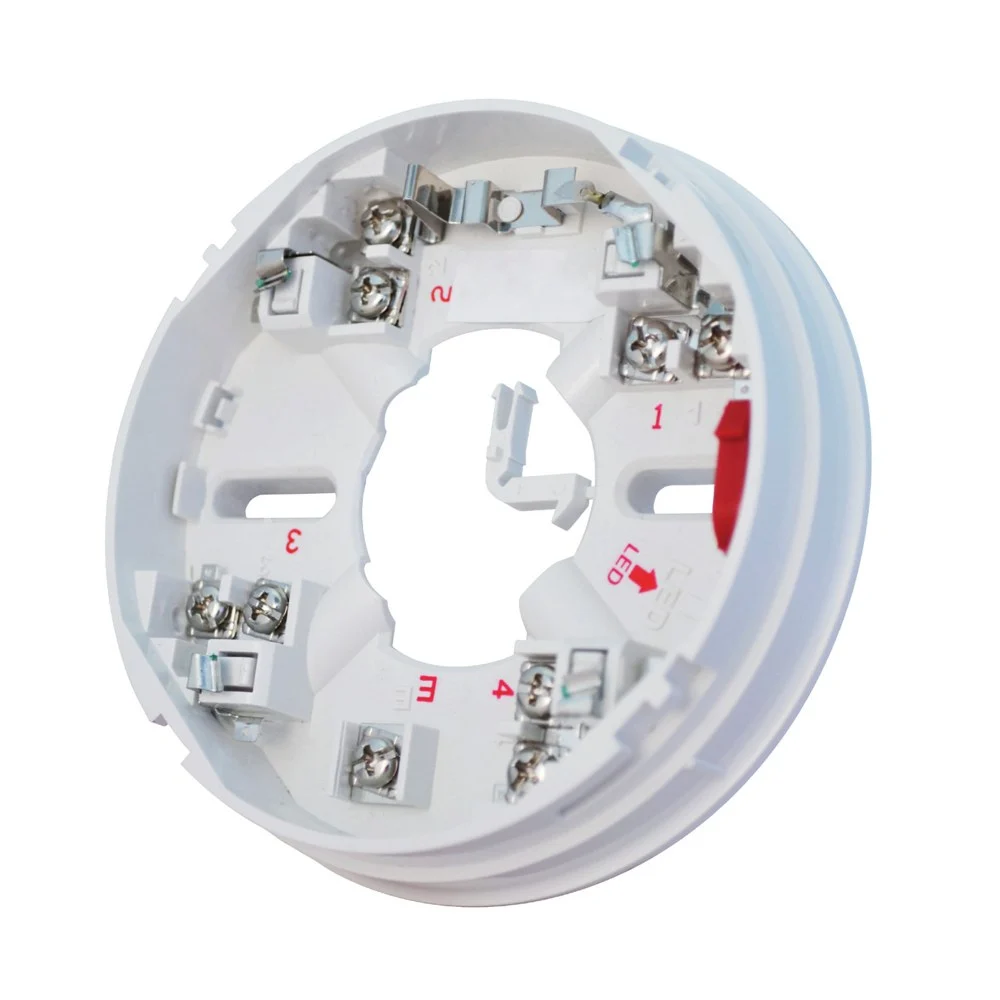
The EATON UCAB300 is the standard base for Eaton UL addressable sensors, designed for flexibility, simplicity and fast installation. An integral shorting link keeps loop continuity if a sensor is removed.
In short
- Integral sensor shorting link; separate loop in/out terminals up to 2 × 2.5 mm².
- Dedicated earth terminal; rear and side cable entry.
- Optional lock prevents sensor removal without a tool.
- Fixes to a standard BESA box or directly to the surface.
What the base does
The base carries the sensor and connects it to the loop. The shorting link keeps the loop continuous when a sensor is removed, and the stand-off feature prevents distortion on uneven surfaces.
Technical data
| Item | Value |
|---|---|
| Model | UCAB300 |
| Construction / colour | PC/ABS, white |
| Dimensions | Ø104 × 22 mm |
| Terminals | 2 × 2.5 mm² per terminal |
The critical point: earth continuity
The cable screen (earth) must be continuous along the loop, and high-voltage testers must not be used with devices connected.
General notes on sensor layout
- Spacing: spot smoke detectors on smooth ceilings are typically laid out at a nominal 30 ft (9.1 m) per NFPA 72, and heat detectors at their listed spacing (50 ft for this range); spacing reduces for high, beamed or sloped ceilings.
- Air movement: keep smoke sensors at least 3 ft (0.9 m) from supply air diffusers, as the airflow can push smoke away from the sensor.
- Type selection: smoke for offices, rooms and corridors; smoke with heat where fast fires are expected; heat for kitchens, car parks and generator rooms with dust or fumes.
- Sensors in lift lobbies and machine rooms are typically used for elevator recall, and duct detectors for HVAC shutdown, per the governing standards.
- Periodic testing: sensors are functionally tested annually and sensitivity-tested periodically per NFPA 72 Chapter 14, with listed test tools.
General engineering notes
These points are general principles from NFPA 72 and common design practice, not from the EATON datasheet. The final decision rests with the project’s approved designer per the adopted edition of the standard and the authority having jurisdiction.
Installation steps
- Fix the base to a BESA box or the surface.
- Wire the loop to its separate terminals and the earth to its terminal.
- Fit the sensor and turn until it clicks; enable the lock if needed.
Common mistakes
- Overtightening on an uneven surface so the base distorts.
- Wiring that obstructs fitting the sensor.
Inspection and maintenance
Before any test or maintenance, notify the owner, the monitoring station and everyone affected, as testing may operate alarms or linked outputs. The owner is responsible for inspection, testing and maintenance per NFPA 72 and the authority having jurisdiction, preferably by a qualified company.
Files and ordering
The EATON datasheet (UCAB300) and the available UL certificate are in the files section of this page. When ordering, state the model UCAB300.
How to order
Use the “Build your order” section on this page: add every model and quantity, then send the whole order by email or WhatsApp. It reaches us as a tidy PDF request sheet and we contact you with the quotation.
FAQ
What happens to the loop if a sensor is removed?
The integral shorting link keeps the loop continuous.
References
- EATON UCAB300 — Datasheet (attached)
- UL 268 — Smoke Detectors for Fire Alarm Systems
- NFPA 72 — National Fire Alarm and Signaling Code
This page is general information to help with selection and ordering, taken from the attached EATON datasheet. Final design is set by the project’s approved designer; the project specification, the consultant’s drawings and the latest datasheet revision govern.