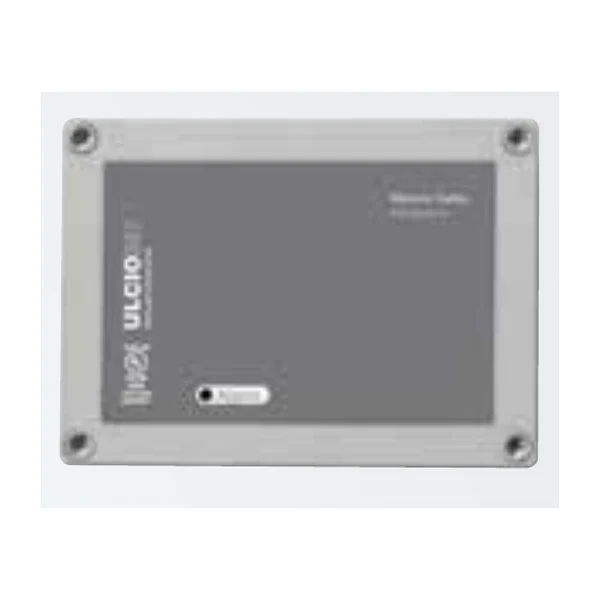
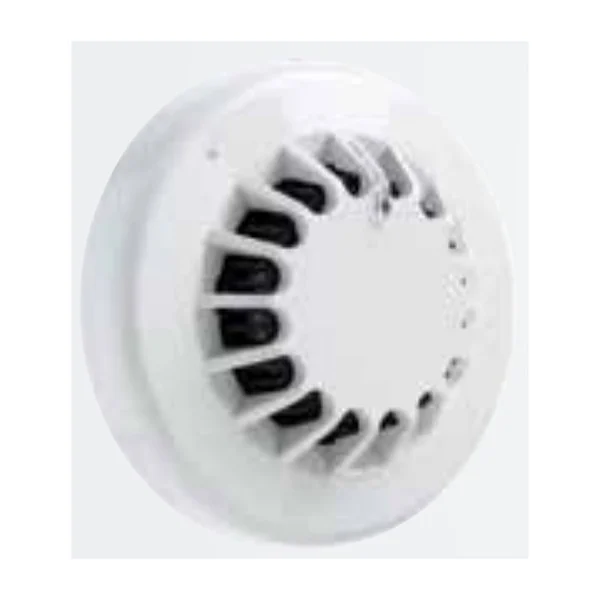
The EATON UCPD-2W is a 2-wire conventional optical smoke detector from the Eaton UL range. As there is no UL certified Eaton conventional panel, it is used with the ULMIU872 micro zone monitor connected to a UL addressable panel. Detectors in this range have a removable chamber and drift compensation.
In short
- 2-wire conventional detector on the CB2E base.
- Requires the ULMIU872 (monitors a zone of up to 20 UL conventional detectors) with an Eaton UL addressable panel.
- Optical smoke detection, suitable for most applications.
- IP40, ceiling mounting in open areas.
When is it used?
Optical detection is fastest for slow, smouldering fires giving large visible smoke particles, and suits most applications.
Conventional detectors on a zone do not give the individual detector location, only the zone monitored by the ULMIU872.
Technical data
| Item | Value |
|---|---|
| Model | UCPD-2W |
| Type | Conventional Optical Smoke Detector |
| Heat element | N/A |
| Heat spacing | N/A |
| Base | CB2E |
| Dimensions | Ø104 mm |
| IP rating | IP40 |
The critical point: it needs a zone monitor
The detector does not connect directly to the addressable loop; it connects to a zone monitored by the ULMIU872, with up to 20 listed detectors per zone.
General notes on sensor layout
- Spacing: spot smoke detectors on smooth ceilings are typically laid out at a nominal 30 ft (9.1 m) per NFPA 72, and heat detectors at their listed spacing (50 ft for this range); spacing reduces for high, beamed or sloped ceilings.
- Air movement: keep smoke sensors at least 3 ft (0.9 m) from supply air diffusers, as the airflow can push smoke away from the sensor.
- Type selection: smoke for offices, rooms and corridors; smoke with heat where fast fires are expected; heat for kitchens, car parks and generator rooms with dust or fumes.
- Sensors in lift lobbies and machine rooms are typically used for elevator recall, and duct detectors for HVAC shutdown, per the governing standards.
- Periodic testing: sensors are functionally tested annually and sensitivity-tested periodically per NFPA 72 Chapter 14, with listed test tools.
General engineering notes
These points are general principles from NFPA 72 and common design practice, not from the EATON datasheet. The final decision rests with the project’s approved designer per the adopted edition of the standard and the authority having jurisdiction.
Installation steps
- Install the CB2E base and wire the zone to the ULMIU872.
- Fit the detector to the base.
- Fit the end-of-line device per the monitor instructions and test the zone.
Common mistakes
- Connecting a conventional detector directly to an addressable loop.
- Exceeding 20 detectors per zone.
- Do not use high-voltage insulation testers while devices or the panel are connected, as the Eaton datasheets warn.
Inspection and maintenance
Before any test or maintenance, notify the owner, the monitoring station and everyone affected, as testing may operate alarms or linked outputs. The owner is responsible for inspection, testing and maintenance per NFPA 72 and the authority having jurisdiction, preferably by a qualified company.
Files and ordering
The EATON UL catalogue and UL certificate are attached. When ordering, state the model UCPD-2W and the CB2E base.
How to order
Use the “Build your order” section on this page: add every model and quantity, then send the whole order by email or WhatsApp. It reaches us as a tidy PDF request sheet and we contact you with the quotation.
FAQ
Why use a conventional detector with an addressable panel?
For small extensions or areas where zone-level monitoring is enough, via the ULMIU872.
References
- EATON UL catalogue — Datasheet (attached)
- UL 268 — Smoke Detectors for Fire Alarm Systems
- NFPA 72 — National Fire Alarm and Signaling Code
This page is general information to help with selection and ordering, taken from the attached EATON datasheet. Final design is set by the project’s approved designer; the project specification, the consultant’s drawings and the latest datasheet revision govern.