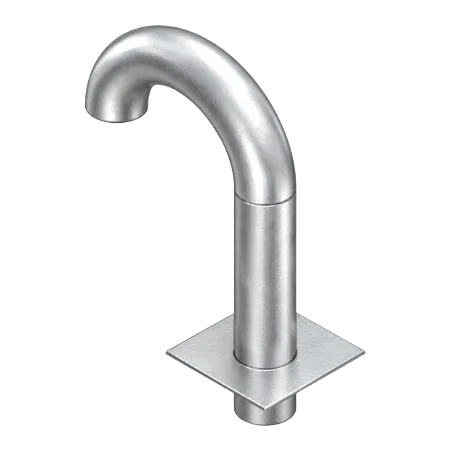
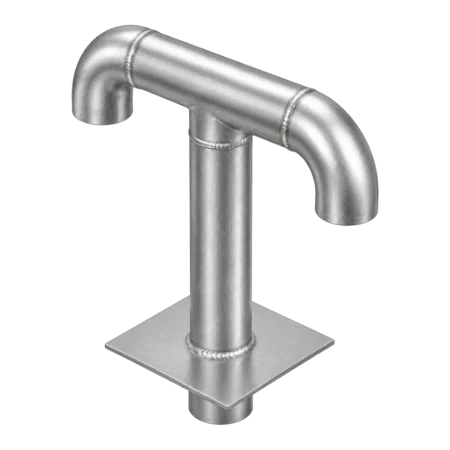
The Fu-Mech double gooseneck vent (model FU-VP2S) is a vent pipe for water tanks, set in the roof slab on a square base plate, with two downturned outlets. It lets the tank breathe as it fills and empties and equalizes the pressure inside and outside, while the downturned outlet keeps rain and debris out. This guide explains why venting matters, compares the types, and covers installation and ordering.
At a glance
- Lets air out while filling and in while emptying.
- Equalizes internal and external tank pressure.
- Downturned outlet keeps rain and debris out.
- Square base plate for the roof slab; welded one-piece construction.
Why does a tank need venting?
As a tank fills, the air occupying the space must get out; as it empties, air must get in to replace the water. Without adequate venting, pressure rises inside the tank while filling, or a vacuum forms while pumps draw from it — making filling difficult, weakening pump suction and stressing the tank itself.
A gooseneck vent solves this: it opens the tank to atmosphere, and its downturned bend keeps rain and debris out.
Comparing the types
| Product | Code | Feature |
|---|---|---|
| Double gooseneck vent — this product | FU-VP2S | Two downturned outlets on one riser |
| Single gooseneck vent | FU-VP1S | One downturned outlet |
| Tank feeding pipe | FU-TFP | Filling inlet with a chained cap |
Venting capacity
Venting must be enough for the tank’s highest filling rate and highest draw-off rate, including fire-pump demand. The number and size of vents are set by the project’s approved designer from the tank capacity and flow rates.
Caution
If the project specification calls for an insect or bird screen on the vent outlet, or a set outlet height above the roof, state it clearly with your order.
Installing in the roof slab
- Mark vent positions on the roof drawing before the pour.
- Set the square base plate in the roof slab at the right level and tie it to the reinforcement.
- Allow for waterproofing layers and the final roof finish when setting the outlet height.
- Seal the pipe-to-roof junction into the waterproofing.
Common mistakes
- Venting smaller than the filling or draw-off rate.
- An outlet too close to the roof surface, reached by ponding rainwater.
- Forgetting the slab thickness and waterproofing when ordering.
- Vent outlets left blocked by dust or debris with no maintenance.
How to order
Use the “Build your order” section on this page: add every model, size and quantity, then send the whole order by email or WhatsApp. It reaches us as a tidy PDF request sheet and we contact you with the quotation.
- Model code FU-VP2S
- Pipe size (DN) and quantity
- Roof slab thickness
- Any special requirement in the specification (screen, outlet height)
Frequently asked questions
What is the difference between the double and single vents?
The double vent FU-VP2S has two outlets on one riser; the single vent FU-VP1S has one. Type, number and size are chosen for the venting capacity the tank needs.
How is it installed in the roof?
The square base plate is set in the concrete roof slab during the pour. Send us the slab thickness so the length below the plate suits it.
How is it made?
Welded one-piece construction by Fu-Mech; size and finish to order.
What should I send for a quotation?
Model code, size, quantity, roof slab thickness and any special requirement in the project specification.
References
- Fu-Mech catalogue — Edition 08/2026 — Vent & feeding pipes
This guide is general information to help with selection and ordering. Final design, sizes and positions are set by the project’s approved designer; the project specification and the consultant’s drawings govern. Specifications may vary by project; datasheets and drawings are available on request.