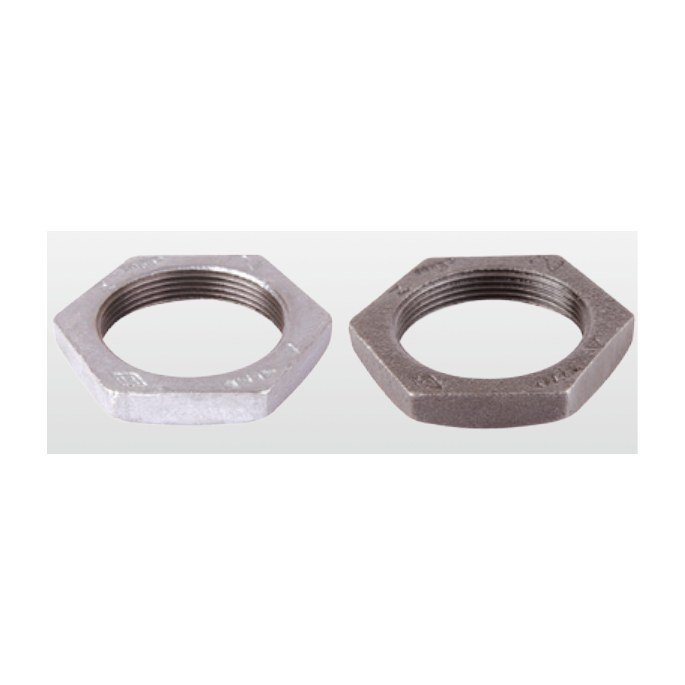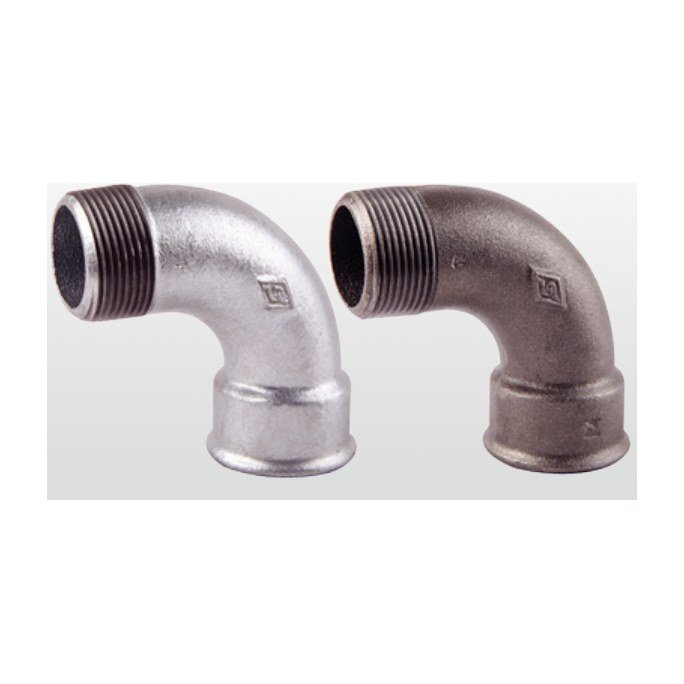

The MECH red bush in black malleable iron, model 241, American Standard Class 150, material ASTM A197/A197M, dimensions ASME B16.3, NPT threads (ASME B1.20.1), sizes 1/4″ × 1/8″ – 8″ × 6″, rated up to 300 psig from -29 to 66 °C, decreasing with temperature per the MECH pressure-temperature table. This guide explains what it does, related models, technical data, correct installation and common mistakes.
At a glance
- A reducing bush fits inside a female fitting to reduce its size: its male thread goes into the larger fitting and its female thread takes the smaller pipe.
- Sizes 1/4″ × 1/8″ – 8″ × 6″, NPT threads.
- Rated up to 300 psig from -29 to 66 °C, decreasing with temperature per the MECH pressure-temperature table.
What is a threaded bush and nipple?
A reducing bush fits inside a female fitting to reduce its size: its male thread goes into the larger fitting and its female thread takes the smaller pipe. A hex nipple joins two female fittings, and a reducing nipple joins two sizes.
Extension pieces and long adapters (female × male) extend an outlet by a set length, for example to set a sprinkler head position relative to a suspended ceiling.
Related models
| Model | Item | Sizes |
|---|---|---|
| 245 | Red NIPPLE | 1/4″ × 1/8″ – 4″ × 3″ |
| 241 — this product | Red BUSH | 1/4″ × 1/8″ – 8″ × 6″ |
| 280 | Hex NIPPLES | 1/8″ – 6″ |
Technical data
| Item | Specification |
|---|---|
| Class | American Standard Class 150 |
| Material | Malleable iron ASTM A197/A197M |
| Dimensions | ASME B16.3, B16.14 (unions B16.39) |
| Threads | ASME B1.20.1 |
| Sizes | 1/4″ × 1/8″ – 8″ × 6″ |
| Temperature (°C) | Pressure (psig) |
|---|---|
| -29 – 66 | 300 |
| 100 | 265 |
| 125 | 225 |
| 150 | 185 |
Dimensions for every size are in the size table at the top of the page. Per the MECH catalogue: tensile strength ≥ 350 MPa, elongation ≥ 10%.
Joints and pressure loss
Every bush or nipple adds a threaded joint, a possible leak point and extra pressure loss. Use a direct reducing fitting (reducing elbow or tee) where possible instead of a bush plus a standard fitting.
Caution
Never mix NPT and BSPT threads: the joint may seem to make up but it will not seal and will leak under pressure.
Installation steps
- Make sure pipe and fitting have the same thread (NPT); never mix NPT and BSPT in one joint.
- Clean and inspect the threads, then apply a suitable sealant (PTFE tape or a thread compound approved for the fluid) to the male thread only.
- Screw the fitting on by hand first, then finish with a wrench for a reasonable number of turns without over-tightening; excessive tightening can split the fitting.
- Support the pipework properly so threaded joints do not carry extra weight or bending.
- Pressure-test the line to the project specification before commissioning.
Common mistakes
- Mixing American NPT and British BSPT fittings in the same line.
- Over-tightening with a wrench or using extension bars, cracking the fitting.
- Wrapping PTFE tape the wrong way or over the first thread, so it enters the line.
- Connecting malleable iron directly to stainless steel or copper without an insulating joint.
Files and ordering
On this page: Product page (catalogue), MECH Malleable Iron Fittings Catalogue (American Standard), Installation & operation manual, Material Safety Data Sheet (MSDS). Add the product to your request list with size and quantity and we send a quotation. Fu-Mech is the exclusive MECH agent in Saudi Arabia.
Frequently asked questions
When should I use a bush instead of a reducing fitting?
When the reducing fitting is not available in the size needed, or when modifying an existing line. In new work a direct reducing fitting is preferred.
Is the thread NPT or BSPT?
This is an American Standard model with NPT threads to ASME B1.20.1. The difference is explained in the guide malleable iron threaded fittings: NPT or BSPT?.
What is the pressure rating?
Rated up to 300 psig from -29 to 66 °C, decreasing with temperature per the MECH pressure-temperature table.
Can they connect to stainless steel or copper pipe?
Per the MECH catalogue, malleable iron threaded fittings must not be connected directly to materials such as stainless steel and copper, because the difference in electrochemical potential causes corrosion. Use a suitable insulating joint.
Are they UL / FM approved?
No approvals are listed for this model in the product data. If your project requires a specific approval, ask us before ordering, or choose from the BS Standard range, which is UL / FM approved.
References
- ASME B16.3 — Malleable Iron Threaded Fittings: Classes 150 and 300
- ASTM A197/A197M — Standard Specification for Cupola Malleable Iron
- ASME B1.20.1 — Pipe Threads, General Purpose, Inch (NPT)
- MECH catalogue — Malleable Iron Pipe Fittings — American Standard
This guide is general information to help with selection. Figures come from the product data on this page and the MECH catalogue; final design is by the project’s approved designer.