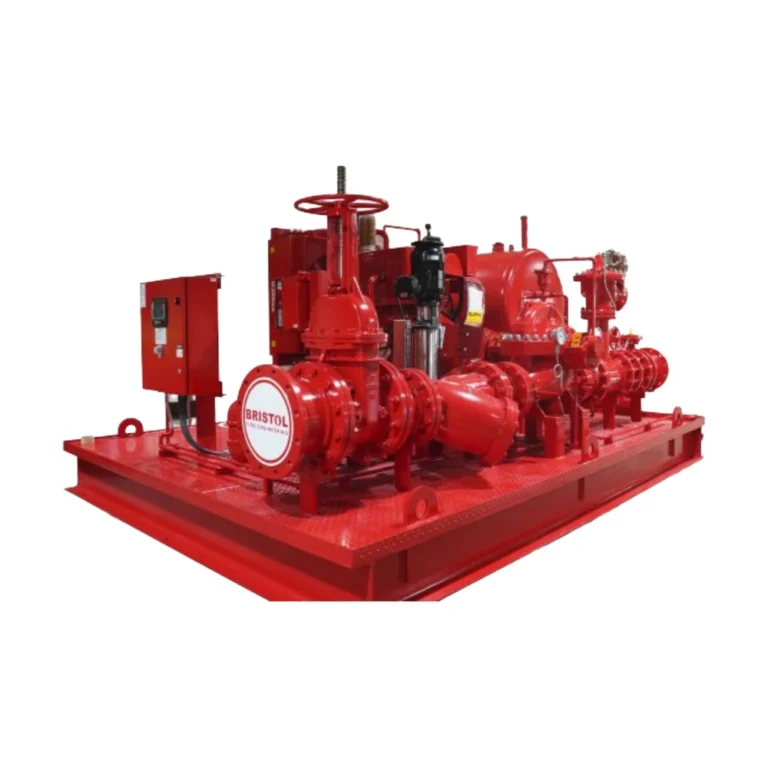
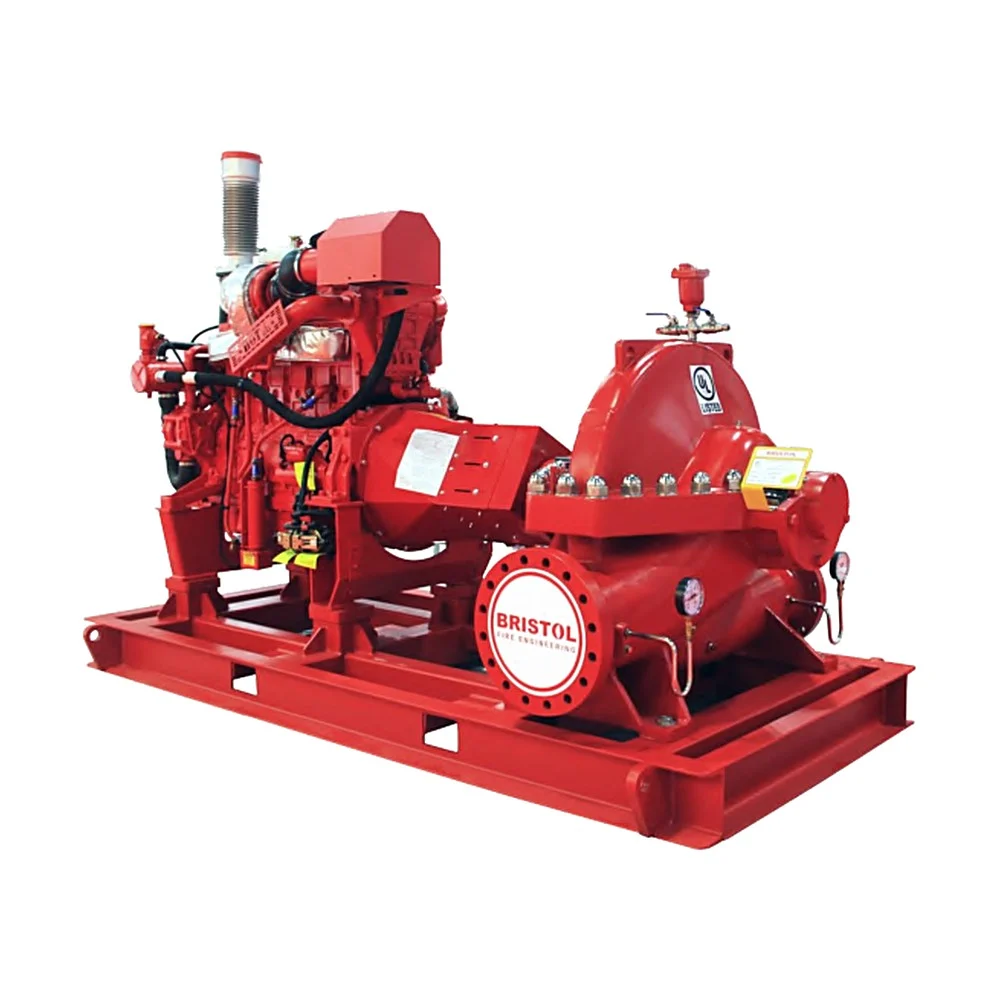
BRISTOL BSP pumps are horizontal split case fire pumps: single stage, non-self-priming centrifugal volute pumps with radial suction and discharge ports. The shaft is horizontal with the impeller at mid-span and a combined bearing housing and seal chamber on each side. The horizontally split casing lets the upper half be removed to reach bearings, wear rings, impeller and shaft seal without disturbing the motor or pipework. The series covers 300 to 3000 GPM at 50 to 209 m head. See the fire pump room valves guide.
In short
- Capacity 300 to 3000 GPM; head 50 to 209 m.
- Ten models in sizes from 5 × 3 to 10 × 8 in.
- Double suction, low NPSH, and low axial and radial shaft loads.
- Bearings and packing can be changed without removing the top casing half.
- UL Listed (File EX16089) and FM Approved for the ratings shown in the catalogue selection chart.
Why split case
The double suction impeller takes water from both sides, balancing the axial forces on the shaft. That extends wear ring, seal and bearing life, reduces vibration, and gives quiet running and higher efficiency.
This is the most common type for medium and large fire pumps, because it is serviced in place.
Technical data
| Item | Value |
|---|---|
| Capacity | 300 – 3000 GPM |
| Head | 50 – 209 m |
| Casing | Ductile iron or cast iron, halves bolted and dowelled for alignment |
| Impeller | Bronze or stainless steel; enclosed, double suction, one-piece cast and balanced |
| Shaft | Stainless steel, alloy steel or duplex steel |
| Shaft sleeve | Stainless steel |
| Wear rings | Bronze |
| Bearings | SKF |
| Sealing | Graphite packing with lantern ring and stainless flush line |
| Flanges | ANSI/ASME B16.1 (cast iron) · B16.42 (ductile iron) |
| Approvals | UL File EX16089; FM per the selection chart |
The critical point: the listed rating for each model and speed
UL and FM cover a specific combination: model, rated capacity, pressure range and speed. The catalogue selection chart gives the UL Listed and FM Approved pressure for each combination, and some are UL only. Where the project requires a particular approval, check the combination in the chart.
The pump is non-self-priming and needs positive suction from the tank.
General design notes on selecting a fire pump
- Rating point: the pump is selected so its rated flow and pressure cover the system demand from the hydraulic calculation.
- Curve shape in NFPA 20: shut-off (no flow) pressure does not exceed 140% of rated pressure, and at 150% of rated flow the pressure is not less than 65% of rated.
- Horizontal pumps need positive suction (water source above the pump). Where the source is below the pump, a vertical turbine pump is used.
- A jockey pump makes up small leaks and holds system pressure, so the main pump starts only on real demand.
- Driver type (electric or diesel) and the number of standby pumps depend on the reliability of the power supply and the authority’s requirements.
- Shut-off pressure plus suction pressure must not exceed the pressure rating of system components; otherwise reselect or manage the pressure per the standard.
General engineering notes
These points are general principles from NFPA 20, NFPA 25 and common design practice, not from the BRISTOL catalogue. Final pump selection is made by the project’s approved designer from the hydraulic calculation and the requirements of the authority having jurisdiction.
Installation steps
- Prepare a level concrete foundation for the set’s weight and grout the base frame to it.
- Connect suction and discharge without loading pipe weight onto the pump flanges, with the suction, discharge and check valves required by NFPA 20.
- Check pump-to-driver coupling alignment after grouting and piping.
- Connect the controller and pressure sensing line, and set the main and jockey pump start pressures.
- Run the field acceptance test with the parties concerned: curve points and automatic start.
Common mistakes
- Oversizing the pump far beyond demand, pushing shut-off pressure above what the system can take.
- An undersized suction pipe or an elbow close to the pump flange, disturbing the flow.
- Skipping coupling alignment after the piping is fixed.
- Leaving the controller in manual or off after testing.
Inspection and maintenance
Per NFPA 25, the fire pump is run periodically at no flow to confirm readiness, and an annual flow test measures the curve points (no flow, rated flow and 150% of rated) against the factory curve.
Inspection, testing and maintenance are the owner’s responsibility per NFPA 25, preferably by a qualified company. Notify the owner, the monitoring station and everyone affected before any test.
Files and ordering
The BRISTOL fire pumps catalogue (with the selection charts and dimensions) is in the files section of this page. For a quotation, state the required flow (GPM), required pressure (psi or bar), driver type (electric or diesel), and whether UL or FM is required.
How to order
Use the “Build your order” section on this page: add every model and quantity, then send the whole order by email or WhatsApp. It reaches us as a tidy PDF request sheet and we contact you with the quotation.
FAQ
Split case vs end suction?
Split case suits larger flows (up to 3000 GPM in this series) and is serviced without removing pipework. End suction is smaller and more economical, covering up to 1000 GPM.
Is a diesel driver available?
Yes, sets are supplied with an electric or diesel driver and the matching controller.
How do I find the right model?
From the required flow and pressure. The models table at the top of the page gives each model’s capacity range, and the catalogue selection chart gives pressures and speeds.
References
- BRISTOL Fire Pumps Issue 6.0 — Datasheet (attached)
- NFPA 20 — Standard for the Installation of Stationary Pumps for Fire Protection
- UL 448 — Centrifugal Stationary Pumps for Fire-Protection Service
- NFPA 25 — Inspection, Testing and Maintenance of Water-Based Fire Protection Systems
This page is general information to help with selection and ordering, taken from the attached BRISTOL datasheet. Final design is set by the project’s approved designer; the project specification, the consultant’s drawings and the latest datasheet revision govern.