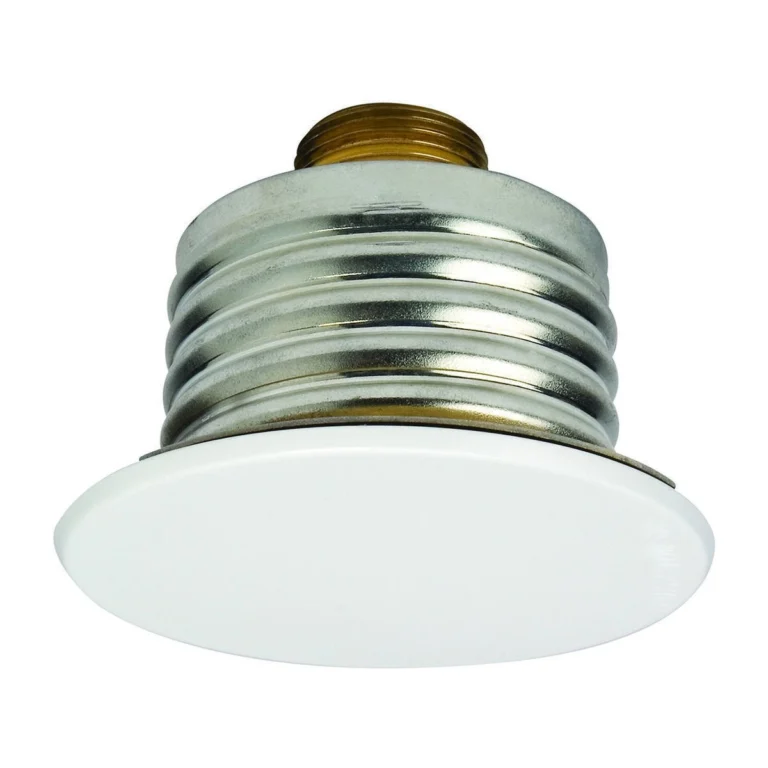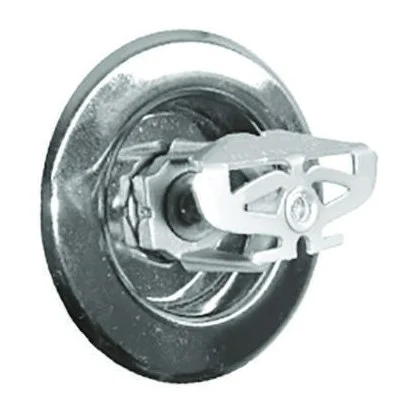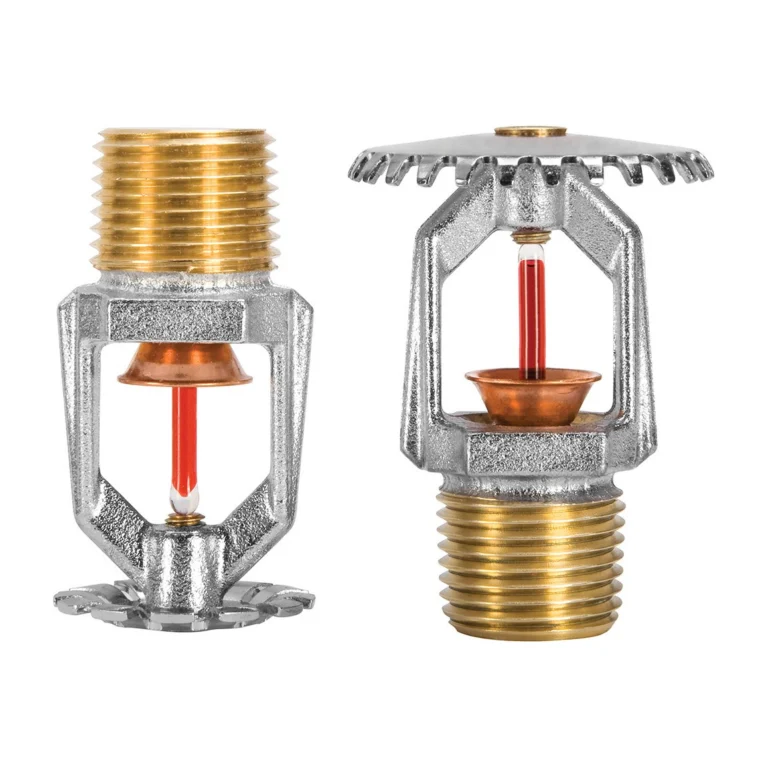
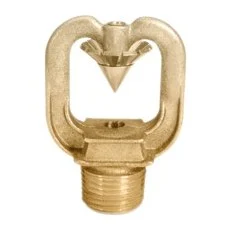
The TYCO Type D3 PROTECTOSPRAY is an open (non-automatic) directional spray nozzle for water spray fixed systems. Its external deflector discharges a uniformly filled cone of medium-velocity droplets to cool exposed vertical, horizontal, curved and irregular surfaces, preventing heat absorption from an external fire and its spread to the protected equipment. See wet, dry, pre-action and deluge systems compared.
In short
- Open nozzle: all nozzles discharge together when the system valve (such as a deluge valve) opens.
- 1/2″ NPT connection, 7 – 14 ft-lb torque with the W-Type 11 wrench.
- Available in several orifice sizes and spray angles per the datasheet, selected to meet the required density.
- Approvals: UL, C-UL and FM.
How the nozzle works
The nozzle is always open, so water reaches it only when the system control valve is opened by the detection system. Water strikes the external deflector and forms a directional spray cone toward the protected surface.
Nozzle aim and spacing set the coverage: spray patterns must fully cover the plane of protection at the required minimum average density.
Technical data
| Item | Value |
|---|---|
| Type | Open directional, medium velocity spray nozzle |
| Connection | 1/2″ NPT |
| Torque | 7 – 14 ft-lb |
| Wrench | W-Type 11 |
| Recommended spacing | Indoor 12 ft (3.7 m) or less, outdoor 10 ft (3.0 m) or less |
| Approvals | UL · C-UL · FM |
The critical point: aiming and spacing
Where the authority requires direct impingement on the whole protected surface, nozzles are spaced and aimed to fully cover the plane of protection. The datasheet recommends indoor spacing of 12 ft or less and outdoor spacing of 10 ft or less.
Installation steps
- Aim each nozzle per the design drawing so the spray covers the protected surface.
- Apply thread sealant and hand-tighten the nozzle.
- Finish with the W-Type 11 wrench only at 7 – 14 ft-lb, keeping the aim.
- Confirm the minimum residual pressure with the authority having jurisdiction.
Common mistakes
- Turning the nozzle while tightening so the coverage misses the protected surface.
- Exceeding the recommended nozzle spacing.
- Choosing an orifice or angle that does not meet the required density.
Inspection and maintenance
Before closing a main control valve for maintenance, obtain permission from the proper authorities and notify everyone affected. The owner is responsible for inspection, testing and maintenance to NFPA 25 and the authority having jurisdiction; any impairment must be corrected immediately.
Inspect nozzles visually for damage, aim and obstruction, especially in corrosive atmospheres.
Files and ordering
TYCO datasheet TFP802 and the available approval certificates are in the files section of this page. When ordering, state the D3 model, orifice size, spray angle and finish. The datasheet lists the part numbers (P/N).
How to order
Use the “Build your order” section on this page: add every model and quantity, then send the whole order by email or WhatsApp. It reaches us as a tidy PDF request sheet and we contact you with the quotation.
FAQ
What is the difference between an open nozzle and a sprinkler?
A sprinkler is closed and opens individually by heat; open nozzles all discharge together when the valve opens.
Where is it used?
To cool and protect equipment and surfaces exposed to an external fire, such as tanks, transformers and structures, within water spray fixed systems.
How do I choose orifice and angle?
From the required density and nozzle-to-surface distance in the design calculation, among the options in the datasheet.
References
- TYCO TFP802 — Datasheet (attached)
- NFPA 15 — Water Spray Fixed Systems
- NFPA 25 — Inspection, Testing and Maintenance of Water-Based Fire Protection Systems
This page is general information to help with selection and ordering, taken from the attached TYCO datasheet. Final design is set by the project’s approved designer; the project specification, the consultant’s drawings and the latest datasheet revision govern.