The hydrostatic test is the final confirmation that the installed network is tight and can hold pressure before it is filled and handed over. The system is filled with water, pressure is raised above the working pressure, and it is held for a set period with no pressure loss and no visible leak. This guide explains the usual values under NFPA 13, preparation, the steps, and common reasons for failure.
Key points
- The well-known NFPA 13 rule for new systems: not less than 200 psi for two hours, or 50 psi above working pressure where system pressure exceeds 150 psi.
- A pass means no pressure loss and no visible leakage throughout the test.
- Every valve and fitting in the line must have a rated working pressure suitable for this test.
- Underground mains are tested under NFPA 24 after flushing.
What the test proves
The test does not measure sprinkler performance or water supply adequacy; it proves the joints, fittings, valves and pipes are tight and correctly installed. A grooved coupling whose housing has not seated in the groove, a thread not tightened enough, or a pinched gasket shows up here, before it shows up after the ceiling is finished.
Test pressure and duration
| Case | Test pressure | Duration |
|---|---|---|
| System working pressure up to 150 psi | At least 200 psi | Two hours |
| System working pressure above 150 psi | Working pressure + 50 psi | Two hours |
| Dry system (additional air test) | Air pressure set in the standard | 24 hours |
For conversion: 200 psi ≈ 13.8 bar. Use the pressure unit converter.
Warning
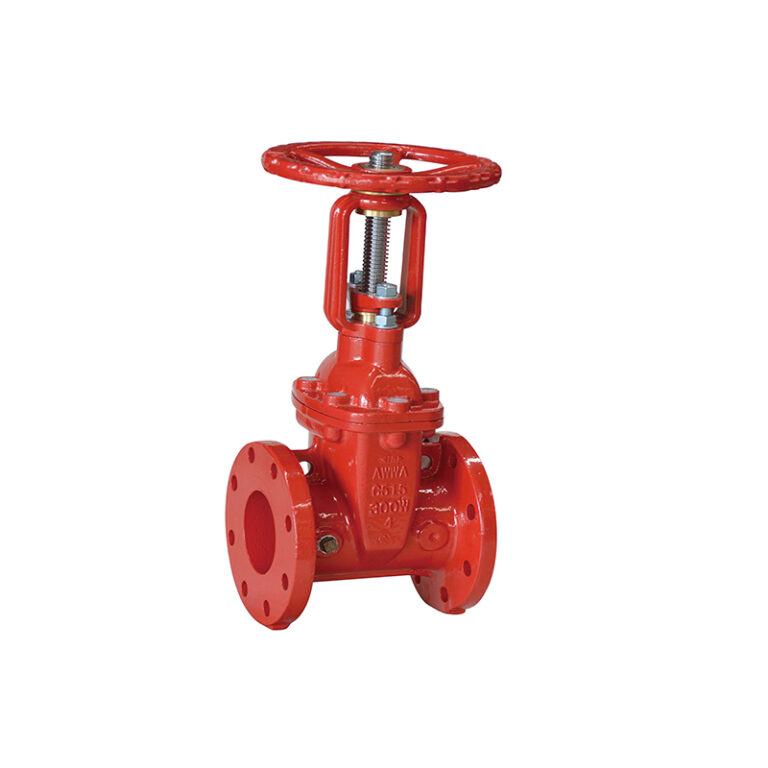
Before testing, check every component’s rated working pressure. MECH fire valves such as the XZ41X OS&Y gate valve are rated 300 PSI per the model table, but any weaker component in the line (a meter, a device, a fitting not intended for fire service) must be isolated or confirmed to withstand the test.
Preparation
- Flush underground and main lines before connecting them, so debris does not reach the valves.
- Isolate devices not designed for the test pressure, or fit temporary plugs in their place.
- Provide a test pump and a calibrated pressure gauge of suitable range at the lowest point, or as the supervisor approves.
- Open high-point vents while filling; trapped air gives misleading readings.
Steps in order
- Fill the system slowly from the bottom and release air from the vents.
- Raise the pressure gradually to the required test pressure.
- Stop the pump, close its valve, and record pressure and time.
- Inspect every joint and valve visually during the period.
- Record the pressure at the end in the presence of the consultant’s engineer, and both sign the test record.
- Release pressure slowly, repair any leak, then retest the affected section.
Common reasons for failure
- A grooved coupling whose housing has not seated in the groove, or a pinched gasket.
- A drain or test valve left partly open.
- Trapped air expanding and contracting with temperature and changing the reading.
- An uncalibrated gauge or one with an unsuitable range.
Frequently asked questions
Can the test be done with air instead of water?
The main test for wet systems is hydrostatic, with water. The additional air test applies to dry and pre-action systems under the standard.
Can additives be put in the test water?
No additives may be used to hide leaks or seal joints. The test must reveal any leak.
Who attends the test?
The contractor and the consultant’s engineer, and the authority having jurisdiction where the project requires it; a signed test record is kept.
References
- NFPA 13 — Standard for the Installation of Sprinkler Systems.
- NFPA 24 — Standard for the Installation of Private Fire Service Mains and Their Appurtenances.
- SBC 801 — Saudi Fire Code.
The values given are those commonly used under NFPA 13; the final reference is the edition adopted on the project and the consultant’s instructions.
Part of a complete guide
This article is part of The Complete Guide to Sprinkler Systems in Saudi Arabia: Types, Components and Testing.