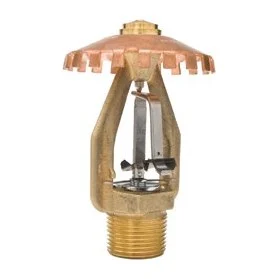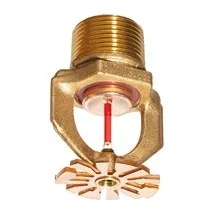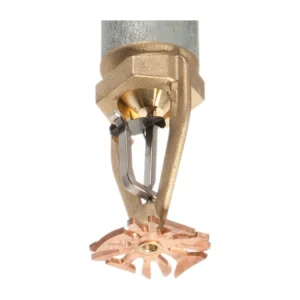
Every fire sprinkler carries a number such as K5.6 or K80. That number is the K-factor, and it sets how much water the sprinkler discharges at a given pressure. It is the basis of every sprinkler hydraulic calculation and of choosing the right sprinkler for the hazard. This guide explains the formula, unit conversion and the common K-factors, with worked examples.
Key points
- The basic formula is Q = K × √P: flow is proportional to the square root of pressure.
- Metric K ≈ imperial K × 14.4, so K5.6 is roughly K80.
- NFPA 13 sets a minimum sprinkler operating pressure of 7 psi (0.5 bar).
- The flow a sprinkler must deliver comes from design density × the area it covers.
The basic formula
Q = K × √P
| Symbol | Meaning |
|---|---|
| Q | Water flow from the sprinkler |
| K | The sprinkler’s K-factor (a constant set by the manufacturer) |
| P | Pressure at the sprinkler |
Because flow follows the square root of pressure, quadrupling the pressure only doubles the flow. That is why raising pump pressure is a poor way to compensate for a small K-factor; choosing a larger K is usually the better answer.
Units: imperial and metric
| System | Q | P | K |
|---|---|---|---|
| Imperial | gpm | psi | gpm/psi½ |
| Metric | L/min | bar | L/min/bar½ |
To convert: metric K ≈ imperial K × 14.4. So a K5.6 sprinkler is effectively K80, and K8.0 is K115.
Common K-factors and their uses
| Imperial | Metric | Typical use |
|---|---|---|
| K5.6 | K80 | Light and ordinary hazard: offices, residential, commercial |
| K8.0 | K115 | Ordinary and extra hazard, light storage |
| K11.2 | K160 | Warehousing, storage and extra hazard |
| K14.0 / K16.8 / K25.2 | K200 / K240 / K360 | High-piled storage, ESFR and CMSA sprinklers |
Worked example 1: flow at a known pressure
What does a K80 sprinkler discharge at 0.5 bar?
Q = 80 × √0.5 = 80 × 0.707 ≈ 56.6 L/min
In imperial units: a K5.6 sprinkler at 7 psi gives 5.6 × √7 ≈ 14.8 gpm.
Worked example 2: pressure needed for a required flow
Rearrange the formula:
P = (Q ÷ K)²
If the design calls for 13 gpm from a K5.6 sprinkler:
P = (13 ÷ 5.6)² ≈ 5.4 psi
Mind the minimum
5.4 psi is below the NFPA 13 minimum operating pressure of 7 psi (0.5 bar). The minimum governs, so the actual flow is 14.8 gpm — more than required.
Where does the required flow come from?
In the density/area method, the flow required from each sprinkler is the design density multiplied by the area the sprinkler covers:
Q = Density × Area
Illustration: a density of 0.10 gpm/ft² and a sprinkler covering 130 ft² give 13 gpm — the flow in the previous example. Density, design area and maximum coverage per sprinkler depend on the hazard classification in the adopted code (NFPA 13 or the Saudi Building Code), and the designer sets them for each project.
What this formula does not cover
The formula describes conditions at the sprinkler only. A full hydraulic calculation adds friction loss in pipe and fittings and elevation differences, working from the hydraulically most remote sprinkler back to the water supply.
Calculate it quickly
Use the sprinkler flow calculator: pick a K-factor, enter pressure or flow, and get the result in metric and imperial units.
Frequently asked questions
Are K5.6 and K80 the same sprinkler?
They are the same K-factor in two unit systems: 5.6 × 14.4 ≈ 80. A sprinkler may be marked with either or both.
Why not just raise the pressure instead of changing the sprinkler?
Flow rises with the square root of pressure: doubling flow needs four times the pressure, which raises pump and pipe requirements. A larger K-factor reaches the required flow at lower pressure.
What is the minimum pressure at a sprinkler?
NFPA 13 sets a minimum operating pressure of 7 psi (0.5 bar). Some sprinkler types or their listings require a higher minimum.
Is this formula enough to design the system?
No. It is only one part of the hydraulic calculation. A full design covers friction and elevation losses, hose allowances and water supply, and is prepared by a qualified designer.
References
- NFPA 13 — Standard for the Installation of Sprinkler Systems.
- SBC 801 — Saudi Fire Code.
- ISO 6182-1 — Requirements and test methods for sprinklers.
This guide is for technical awareness and does not replace the full hydraulic calculations prepared by the project’s approved designer.
Part of a complete guide
This article is part of The Complete Guide to Sprinkler Systems in Saudi Arabia: Types, Components and Testing.