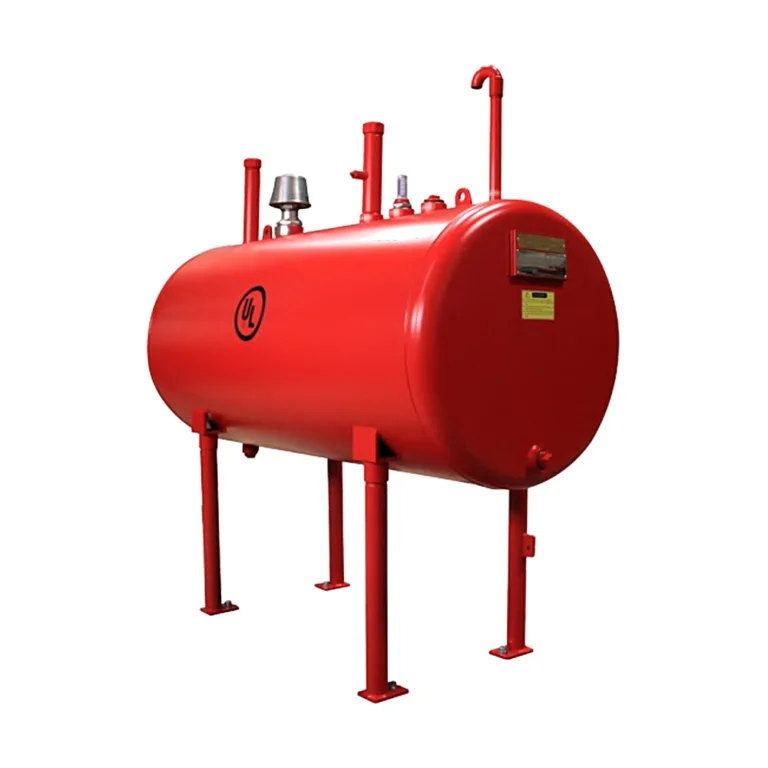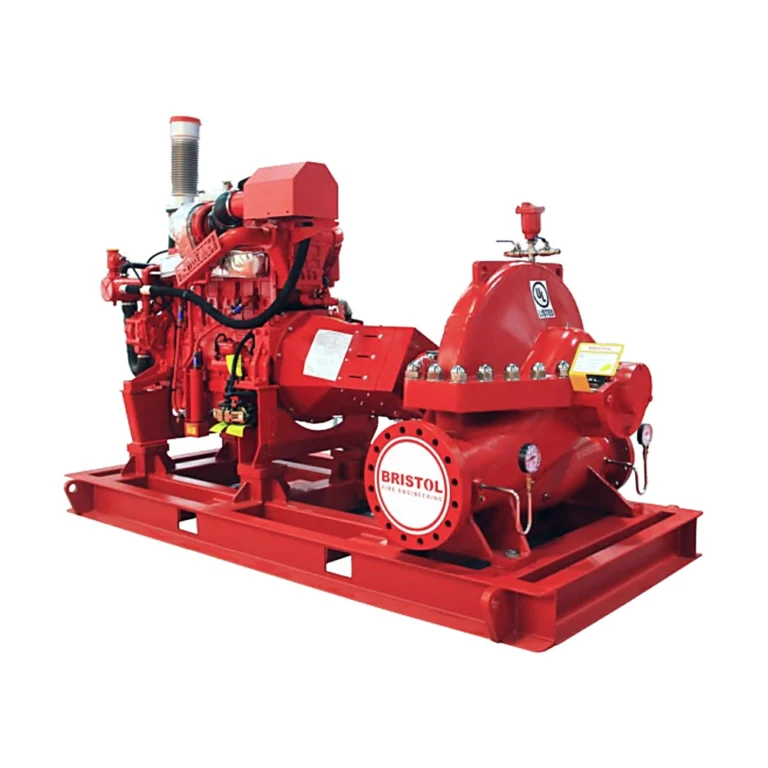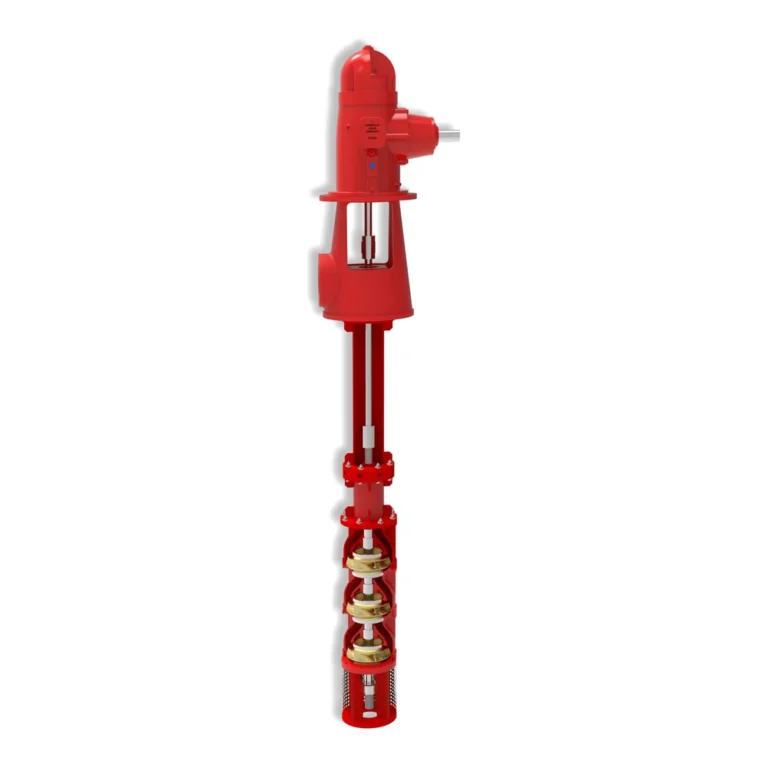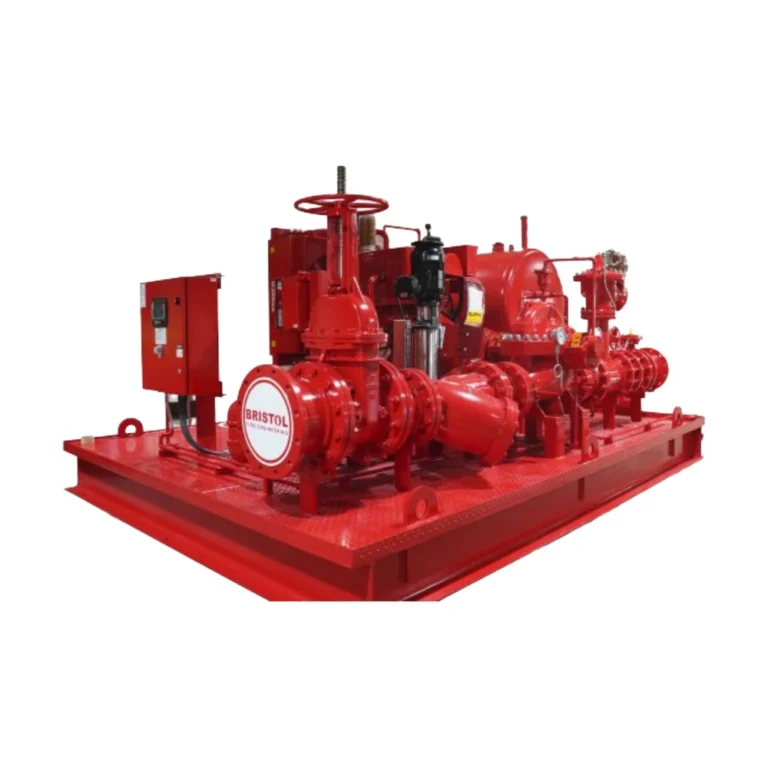
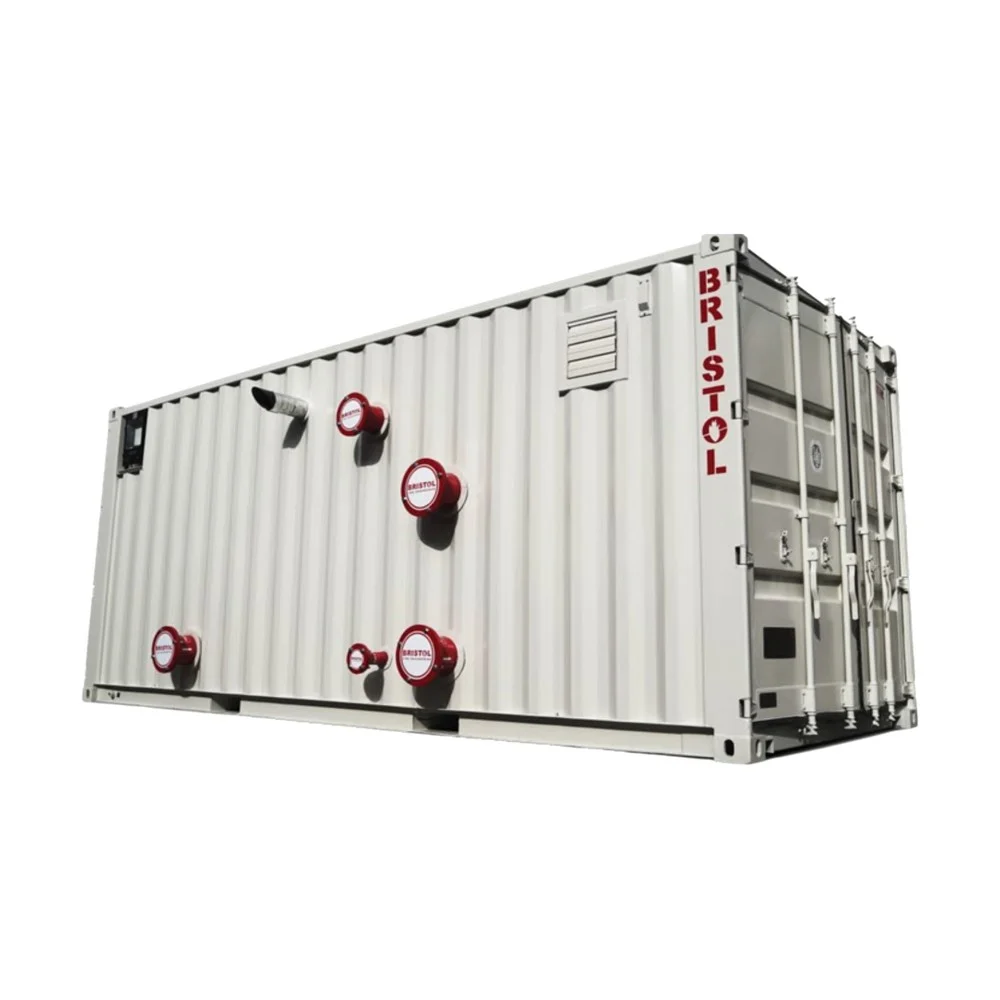
BRISTOL containerized fire pump sets are a complete pump house assembled inside a modified container to customer specifications and NFPA requirements. Main fire pumps, jockey pump, controllers and all accessories are mounted inside, from a single pump to multi-pump systems. They arrive factory tested; on site only power and pipe connections are made and the system is ready. See the fire pump room valves guide.
In short
- 20 ft and 40 ft standard and high cube containers, or a custom built pump house.
- Fire-rated or fire-retardant, weatherproof enclosure as required.
- Flow up to 5500 GPM; pressure 40 to 200 m.
- UL/FM listed range: up to 3000 GPM.
- Engineered and built to NFPA 20, and factory tested.
- On site, only power and pipe connections are made.
What the set contains
Typical scope of supply: UL/FM main pump (split case or end suction) with electric and diesel drive, jockey pump, electric, diesel and jockey controllers, suction and discharge gauges, air release and casing relief valves, piping with valves for suction, discharge, test line and PRV, check, butterfly and OS&Y gate valves, SS 304 pressure sensing line, and flow meter. Inside the container too: complete internal wiring, smoke or heat detector, lighting and emergency light, ventilation fans with louvres, distribution board, sprinkler system, insulated exhaust line, and batteries.
Walls and roof are sandwich panels (PIR / PU / Rockwool / Honeycomb to specification), the floor has a waterproof GRP lining, and paint is a three-coat system inside and out. Large equipment is reached through doors around the container.
Optional additions: breeching inlet with cabinet, fire hose cabinet with landing valve, manual pull station, sounder and strobe, addressable fire alarm panel, extinguishers, and air conditioning.
Technical data
| Item | Value |
|---|---|
| Flow | Up to 5500 GPM |
| Pressure | 40 – 200 m |
| UL/FM listed range | Up to 3000 GPM, 40 – 200 m |
| Enclosure | 20 ft or 40 ft standard or high cube, or custom built |
| Walls and roof | Sandwich panels |
| Floor | Waterproof GRP lining |
| Piping included | Suction, discharge, test, PRV and sensing lines, fuel in and out, pump and engine drains |
The critical point: the scope is confirmed per project
The catalogue states that the scope shall be confirmed for the project. The list above is typical; actual items are fixed in the quotation and approved drawings.
UL/FM applies to the pumps within the 3000 GPM range, not to the container as a unit.
General design notes on selecting a fire pump
- Rating point: the pump is selected so its rated flow and pressure cover the system demand from the hydraulic calculation.
- Curve shape in NFPA 20: shut-off (no flow) pressure does not exceed 140% of rated pressure, and at 150% of rated flow the pressure is not less than 65% of rated.
- Horizontal pumps need positive suction (water source above the pump). Where the source is below the pump, a vertical turbine pump is used.
- A jockey pump makes up small leaks and holds system pressure, so the main pump starts only on real demand.
- Driver type (electric or diesel) and the number of standby pumps depend on the reliability of the power supply and the authority’s requirements.
- Shut-off pressure plus suction pressure must not exceed the pressure rating of system components; otherwise reselect or manage the pressure per the standard.
General engineering notes
These points are general principles from NFPA 20, NFPA 25 and common design practice, not from the BRISTOL catalogue. Final pump selection is made by the project’s approved designer from the hydraulic calculation and the requirements of the authority having jurisdiction.
Installation steps
- Send the project specification: flow, pressure, number of pumps, driver types and site space.
- Review and approve the package drawings before fabrication.
- Prepare the foundation and connection points (suction, discharge, power, drains).
- Lift by the designated lifting points and connect piping and power.
- Run the field acceptance test.
Common mistakes
- Ordering without stating the site space and access route.
- Assuming every scope item is included: the scope of supply is confirmed per project.
- Overlooking diesel engine ventilation and exhaust.
Inspection and maintenance
Per NFPA 25, the fire pump is run periodically at no flow to confirm readiness, and an annual flow test measures the curve points (no flow, rated flow and 150% of rated) against the factory curve.
Inspection, testing and maintenance are the owner’s responsibility per NFPA 25, preferably by a qualified company. Notify the owner, the monitoring station and everyone affected before any test.
Files and ordering
The BRISTOL fire pumps catalogue (with the selection charts and dimensions) is in the files section of this page. For a quotation, state the required flow (GPM), required pressure (psi or bar), driver type (electric or diesel), and whether UL or FM is required, plus the number of pumps and site space.
How to order
Use the “Build your order” section on this page: add every model and quantity, then send the whole order by email or WhatsApp. It reaches us as a tidy PDF request sheet and we contact you with the quotation.
FAQ
When do I choose a containerized set?
Where the building has no pump room, time is short, or a relocatable solution is needed. It arrives ready and tested.
What is needed on site?
A concrete base, suction and discharge connections, power, and fuel for the diesel.
References
- BRISTOL Fire Pumps Issue 6.0 — Datasheet (attached)
- NFPA 20 — Standard for the Installation of Stationary Pumps for Fire Protection
- NFPA 25 — Inspection, Testing and Maintenance of Water-Based Fire Protection Systems
This page is general information to help with selection and ordering, taken from the attached BRISTOL datasheet. Final design is set by the project’s approved designer; the project specification, the consultant’s drawings and the latest datasheet revision govern.