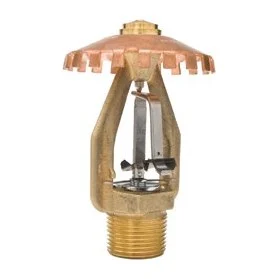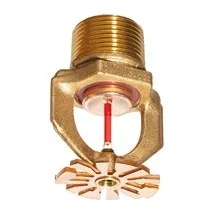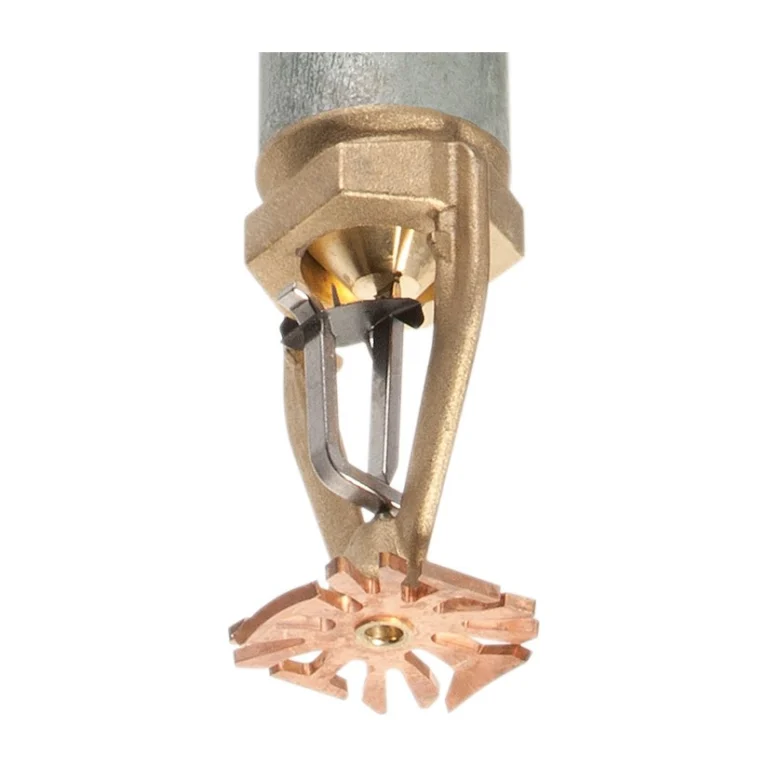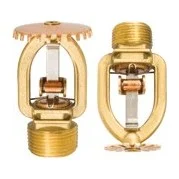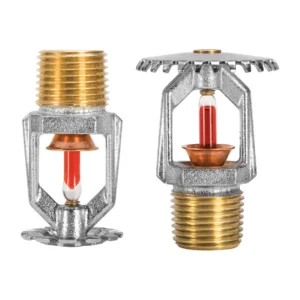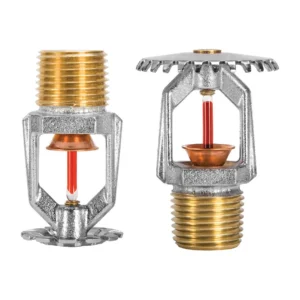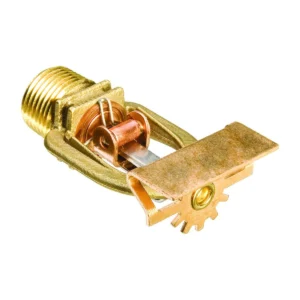
In high-piled warehouses a conventional sprinkler struggles to reach the fire: the rising plume is strong and water evaporates before it arrives. The ESFR (early suppression, fast response) sprinkler was designed for exactly this: it operates early and discharges large drops at a high flow that penetrate the plume and suppress the fire in its early stage, rather than only controlling it. This guide explains the idea and its conditions, with the TYCO ESFR-17 models.
Key points
- Its aim is to suppress the fire at an early stage, whereas a conventional storage sprinkler usually aims to control it.
- A large K-factor (K 16.8 for ESFR-17) and a fast-response element.
- In many cases it is designed at the ceiling only, without in-rack sprinklers, within limits of ceiling and storage height.
- Highly sensitive to obstructions below it and to the deflector distance from the ceiling.
- Designed to NFPA 13 or FM Global standards, using their own tables.
How ESFR works
The fast-response element operates the sprinkler while the fire is still small. The large orifice gives a high flow at moderate pressure, and the deflector forms large drops with enough momentum to penetrate the fire plume and reach the burning surface. The result is that a few sprinklers operate and suppress the fire, instead of a large area of sprinklers opening.
When it is used
In warehouses and distribution centres with high rack or solid-pile storage, where the ceiling height, commodity and storage arrangement allow it under the standard’s tables. Its big advantage is that it can remove the need for in-rack sprinklers, making later changes to the warehouse layout easier.
TYCO ESFR-17 models
| Model | Type | K-factor | Connection | Approval | Datasheet |
|---|---|---|---|---|---|
| TY7126 | Upright | 16.8 | 3/4″ NPT | FM | TFP316 |
| TY7236 | Pendent | 16.8 | 3/4″ NPT | UL · C-UL · FM | TFP322 |
| TY7229 | Dry pendent | 16.8 | 1″ NPT / grooved | UL · C-UL · FM | TFP320 |
The critical point: the conditions it depends on
- Ceiling and storage height: each K-factor has a maximum ceiling and storage height and a minimum operating pressure, given in the standard’s tables.
- Obstructions: ducts, lights and beams below the sprinkler break up the spray, and the ESFR obstruction rules are stricter than for conventional sprinklers.
- Deflector distance below the ceiling: set precisely in the datasheet.
- System type: used mainly in wet systems; the dry model TY7229 serves a freezing area from a wet system.
- Water supply: the number of design sprinklers and the higher pressure may call for a suitable fire pump.
Warning
Changing the commodity or storage height, adding a mezzanine or racks with solid shelves can take a warehouse outside the ESFR design. Any change is reviewed with the approved designer before it is made.
Design steps in brief
- Establish the commodity, storage arrangement and storage height.
- Establish the ceiling height and slope.
- Choose the K-factor and minimum pressure from the standard’s tables.
- Review obstructions and installation clearances.
- Calculate the hydraulic demand and confirm the water supply and pump.
Common mistakes
- Installing ESFR below a wide duct or light fitting without the additional sprinklers the obstruction rules require.
- Mixing ESFR and conventional sprinklers in the same area.
- Raising storage above the design height after handover.
- Choosing a model without the approval the project requires (UL or FM).
Frequently asked questions
Does ESFR always remove the need for in-rack sprinklers?
In many cases yes, but it depends on the commodity, racks, ceiling and storage height under the standard’s tables.
Can ESFR be used in dry pipe systems?
It is used mainly in wet systems. The dry sprinkler TY7229 is intended to serve a cold area from a wet system; details are in its datasheet.
How does ESFR differ from an extended coverage sprinkler?
Extended coverage increases the area each sprinkler protects. ESFR aims to suppress high-piled storage fires through large drops and early operation.
References
- NFPA 13 — Standard for the Installation of Sprinkler Systems (storage chapters)
- FM Global Data Sheet 8-9 — Storage of Class 1, 2, 3, 4 and Plastic Commodities
- TYCO — Datasheets TFP316, TFP320 and TFP322
Product information comes from its pages on this site and the manufacturer datasheets; other points are general engineering practice. Final design and selection rest with the project’s approved designer.
Part of a complete guide
This article is part of The Complete Guide to Sprinkler Systems in Saudi Arabia: Types, Components and Testing.