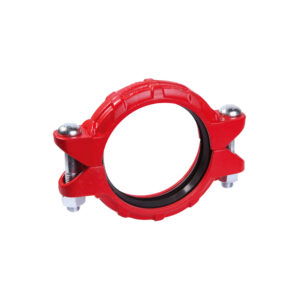
Grooved couplings have become the fastest way to run fire protection and water pipework instead of welding and flanges. Before ordering, though, you have to choose the type: rigid or flexible. The wrong choice causes either unwanted movement in the line, or vibration and stress passed on to equipment. This guide explains the difference, when to use each, and how to pick the model.
Key points
- Rigid couplings lock the two pipes and behave much like a weld: for straight runs, risers and plant rooms.
- Flexible couplings allow limited angular deflection and axial movement: at pumps, for thermal movement and for seismic requirements.
- Lines with flexible couplings need more restraint and support.
- Pressure rating varies by model and size; the product table is the reference.
How does a grooved coupling work?
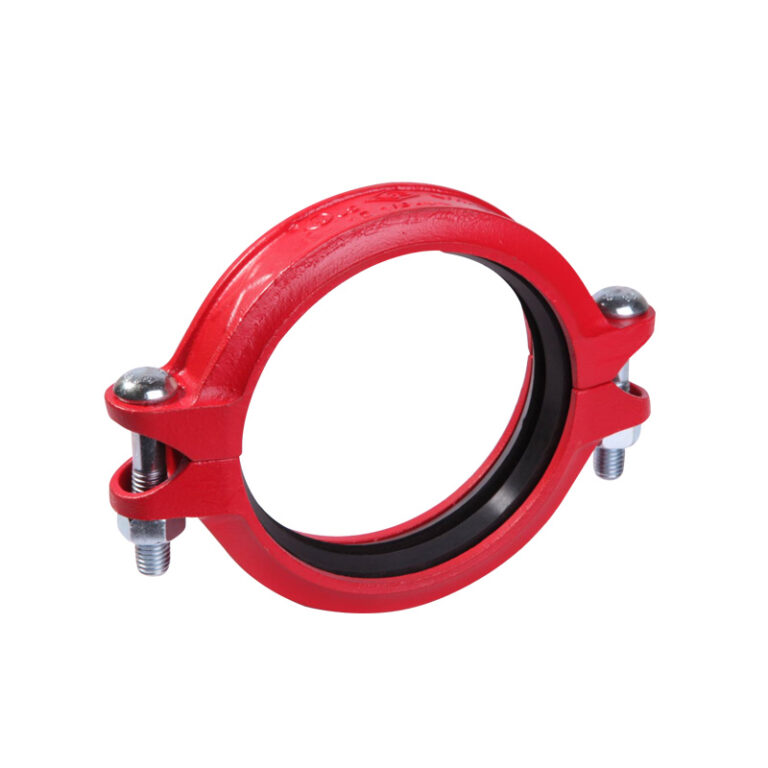
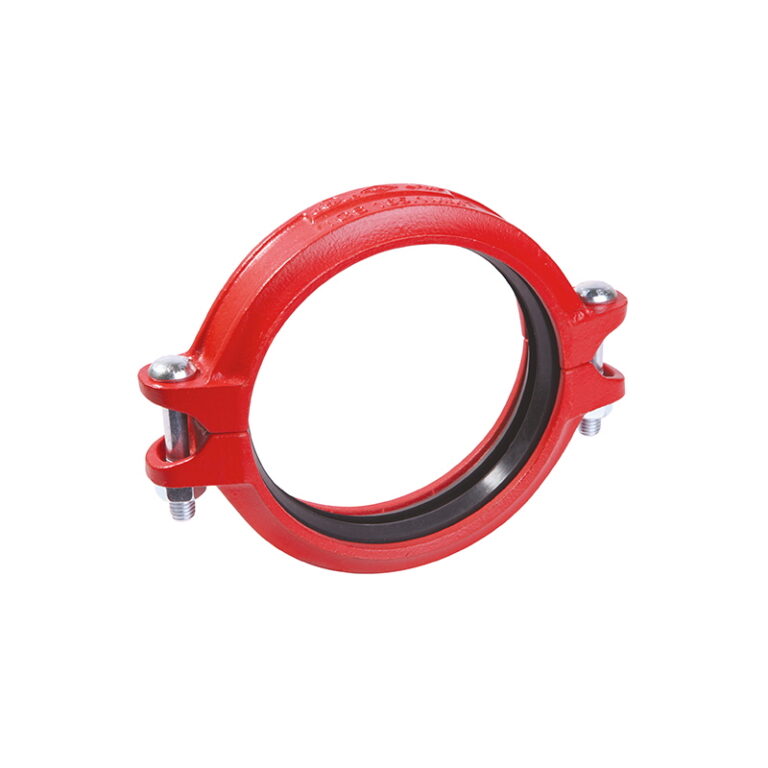
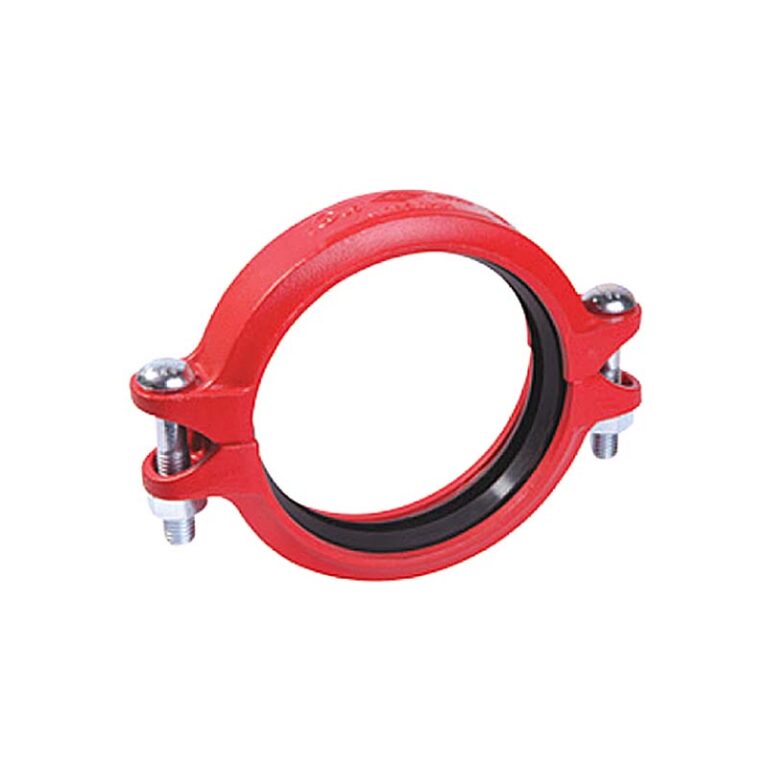
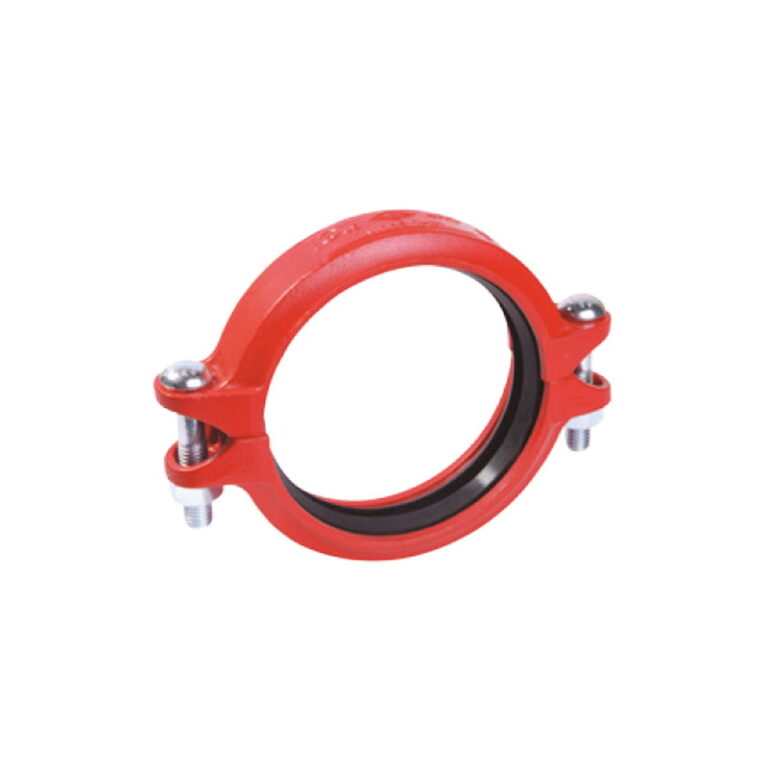
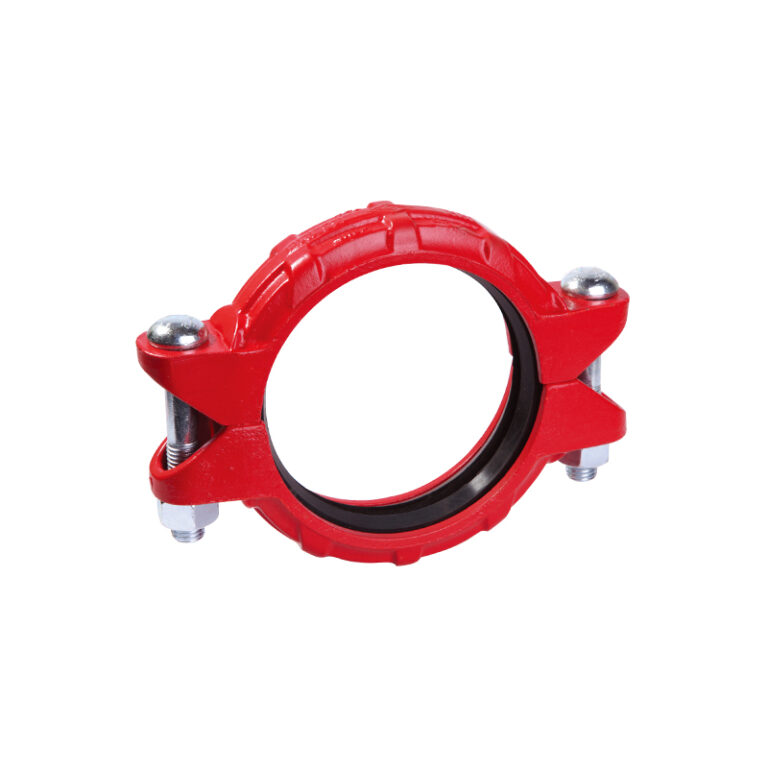
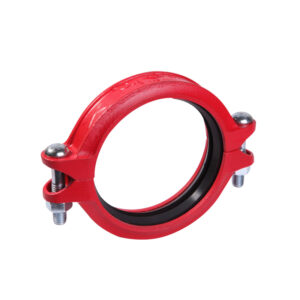
A groove is formed near the end of each pipe, a rubber gasket is fitted over both ends, and a two-piece housing is closed over it with two bolts. The housing keys engage the grooves to hold the pipes, and the gasket seals — more tightly as water pressure rises. Rigid and flexible couplings differ in the shape of the housing and how it grips the groove.
Rigid couplings
The housing is designed to clamp onto the pipe inside the groove, so the joint behaves much like a weld: it allows no meaningful angular deflection or axial movement.
- Suited to long straight runs, risers and plant rooms that need a fixed line.
- Need fewer additional supports than flexible couplings, because the line stays rigid.
Flexible couplings
They leave a controlled gap between pipe ends and allow slight angular deflection and limited axial movement within the manufacturer’s limits.
- Vibration and noise isolation: at pumps and rotating equipment.
- Thermal expansion and contraction: on long runs.
- Seismic movement and building settlement: where seismic protection is required, NFPA 13 calls for flexible couplings at specific locations, including near the top and bottom of risers.
- Minor misalignment during installation.
Caution
Because flexible couplings allow movement, lines that contain them must be adequately supported and restrained so they do not move under water pressure or when the pump starts.
Quick comparison
| Item | Rigid | Flexible |
|---|---|---|
| Movement allowed | Practically none | Limited angular deflection and axial movement |
| Vibration isolation | Limited | Good |
| Supports | Fewer | More restraint needed |
| Typical use | Straight runs, risers, plant rooms | At pumps, thermal movement, seismic requirements |
MECH models
| Model | Type | Sizes | Max. working pressure |
|---|---|---|---|
| 1G | Rigid | 1″ – 32″ (DN25 – DN800) | up to 500 PSI |
| 1GS | Rigid | 3″ – 10″ (DN80 – DN250) | up to 350 PSI |
| 1GX | Rigid | 1-1/4″ – 10″ (DN32 – DN250) | By size — see product table |
| 1N | Flexible | 1″ – 24″ (DN25 – DN600) | up to 500 PSI |
| 1NX | Flexible | 2″ – 10″ (DN50 – DN250) | By size — see product table |
| 1NH | Heavy duty | 2″ – 18″ (DN50 – DN450) | up to 750 PSI |
All models are ductile iron ASTM A536 Gr. 65-45-12 to ASTM F1476, with a Grade “E” EPDM gasket for sprinkler service. The product tables give, for each size, the maximum end load and the permitted pipe-end separation.
Choosing the gasket
A Grade “E” EPDM gasket is the usual choice for fire and water systems. Lines carrying oils or petroleum products need a nitrile gasket that resists them. Always check the manufacturer’s data sheet for temperature limits and service.
Points to check when ordering and installing
- Groove type: roll grooving is common for Sch 10 and Sch 40 pipe; cut grooving suits heavier walls. Follow the manufacturer’s groove dimensions.
- Outside diameter: make sure the coupling matches the pipe OD; some sizes have two or more, such as 2-1/2″ at 73.0 or 76.1 mm. Use the size converter to check.
- Approval: for fire systems, order couplings that are UL Listed / FM Approved for the size and pressure required.
- Bolt tightening: follow the manufacturer’s instructions — typically until the housing pads meet (pad-to-pad) or as the data sheet specifies.
Frequently asked questions
Can flexible couplings be used throughout a line?
Technically yes, but the line then needs far more restraint and support to stop it moving under pressure. The usual practice is rigid couplings on straight runs and flexible couplings where movement is needed.
Where does NFPA 13 require flexible couplings?
Where seismic protection is required, NFPA 13 specifies locations for flexible couplings, including near the top and bottom of risers. The designer sets exact locations under the code adopted for the project.
How does 1N differ from 1NH?
Both cover a wide size range, but 1NH is a heavy-duty coupling rated up to 750 PSI in some sizes, against up to 500 PSI for model 1N.
Will a coupling fit a pipe with a slightly different OD?
No. The coupling must match the pipe OD in the product table; even a small difference stops the housing and gasket from seating correctly.
References
- NFPA 13 — Standard for the Installation of Sprinkler Systems.
- ASTM F1476 — Performance of Gasketed Mechanical Couplings for Use in Piping Applications.
- AWWA C606 — Grooved and Shouldered Joints.
- UL 213 — Rubber Gasketed Fittings for Fire-Protection Service.
- FM Class 1920 — Pipe Couplings and Fittings for Fire Protection Systems.
- MECH size tables for models 1G, 1GS, 1GX, 1N, 1NX and 1NH on the product pages below.
This guide is for technical awareness and does not replace the manufacturer’s data sheet or the requirements of the project’s approved designer.
Part of a complete guide
This article is part of The Complete Guide to Grooved Piping Systems: How They Work, Selection, Installation and Inspection.