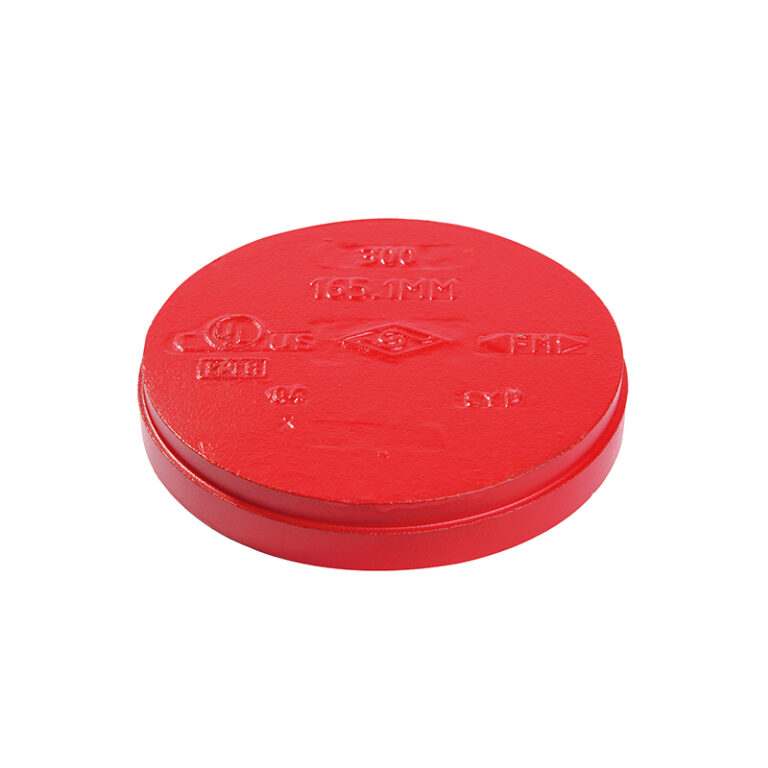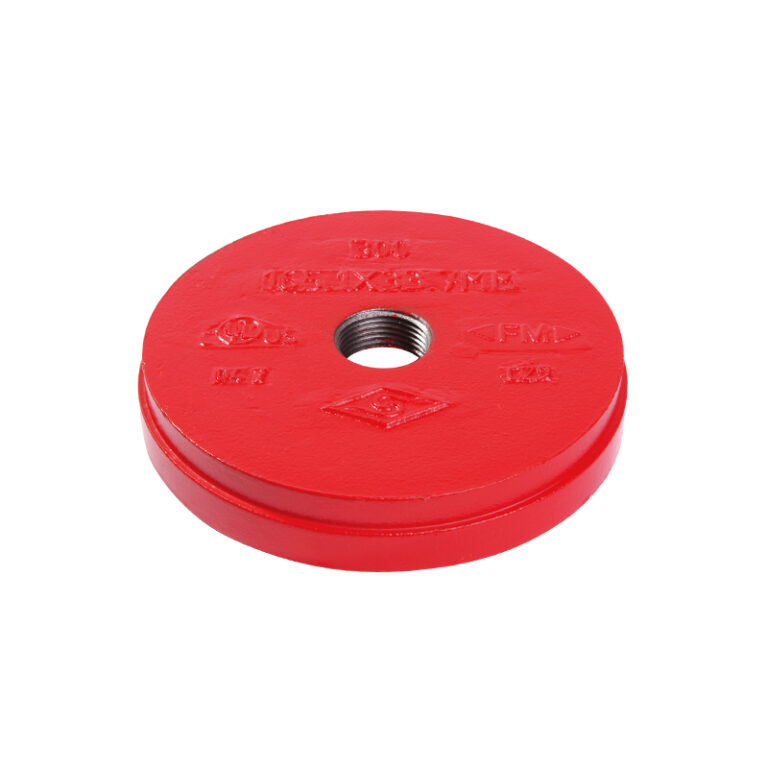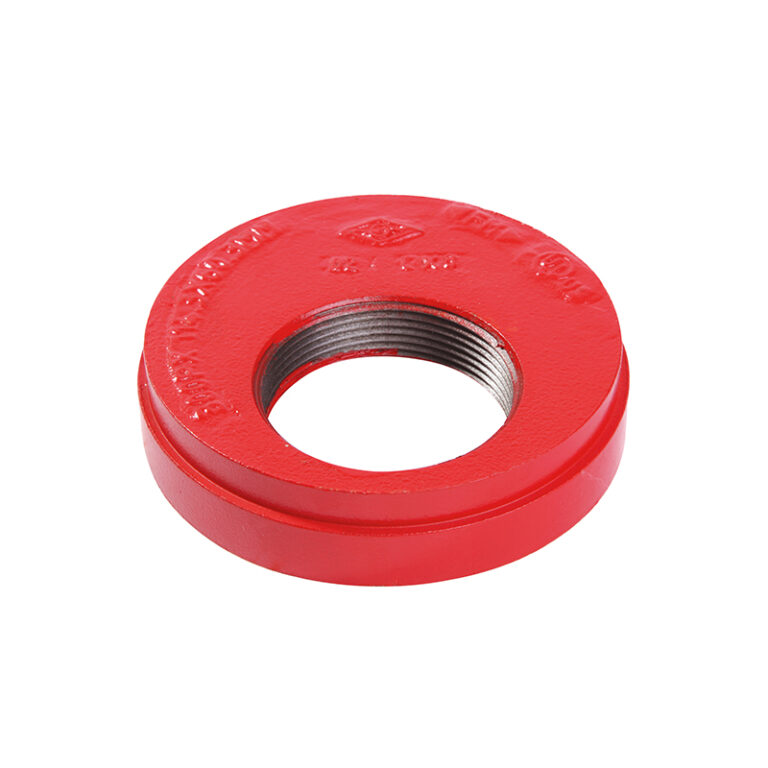
A grooved end cap closes the end of a grooved pipe in fire protection and water systems, and is joined with a standard grooved coupling like any other fitting. It needs no welding or flange, and can be removed later if the line has to be extended. This guide covers the types, how to read the size table, and what to state in your order so the cap matches the pipe on site.
Key points
- A cap does not work on its own: it needs a grooved coupling of the same size to hold it on the pipe.
- Three types: plain, centre threaded outlet and eccentric outlet.
- One nominal size can come in more than one outside diameter; state the OD in millimetres when ordering.
- Working pressure and approvals vary by size; the product table is the reference.
How is a grooved end cap installed?
The cap has a grooved end matching the pipe end. The pipe and the cap are butted together, the gasket is fitted over both, and the grooved coupling is closed with two bolts. The housing keys engage both grooves to join the parts, and the gasket seals — more tightly as line pressure rises.
The end of the line can therefore be opened later by removing a single coupling, which helps with extensions and with flushing and cleaning the pipework.
The three types
| Type | Model | Sizes | Working pressure | Use it for |
|---|---|---|---|---|
| Plain cap | 300 | 1″ – 24″ (DN25 – DN600) | 500 PSI up to 12″; 300 PSI from 14″ to 24″ | Closing the end of a line |
| Centre threaded outlet | 300TX | 2″ × 1″ – 8″ × 1″ and other sizes in the product table | 500 PSI | Line ends that need a small connection such as a valve or gauge |
| Eccentric outlet | 300PX | 2-1/2″ × 1″ – 12″ × 1-1/2″ | 500 PSI | Line ends that need an outlet near the bottom of the pipe |
Why an eccentric outlet?
With the 300PX installed so the outlet is at the bottom, the outlet sits close to the bottom of the pipe. That lets water drain from the end of the line more completely than a centre outlet allows.
Check the pipe outside diameter
The nominal size in inches is not enough on its own. Some sizes come in more than one outside diameter depending on the pipe standard used on the project, and the cap and coupling must match the actual OD:
| Nominal size | DN | Available ODs (mm) |
|---|---|---|
| 2-1/2″ | DN65 | 73.0 / 76.1 |
| 4″ | DN100 | 108.0 / 114.3 |
| 5″ | DN125 | 133.0 / 139.7 / 141.3 |
| 6″ | DN150 | 159.0 / 165.1 / 168.3 |
| 8″ | DN200 | 216.3 / 219.1 |
| 12″ | DN300 | 318.5 / 323.9 |
Caution
Measure the OD of the pipe on site or take it from the project pipe specification, and state it in millimetres for both the cap and the coupling. The difference between two close ODs, such as 165.1 and 168.3 mm, is invisible to the eye but prevents a correct installation.
Material, finish and design standards
- Material: ductile iron ASTM A536 Gr. 65-45-12.
- Design standards: ASTM F1548, AWWA C606, ISO 6182-12.
- Coating: electrophoretic as standard, with epoxy or hot-dip galvanizing as options.
- Approvals: UL, FM, VdS and LPCB depending on size; sizes from 14″ up in the Model 300 table carry no listing, so check them if the project specification requires one.
What to state in your order
- Nominal size and pipe OD in millimetres.
- Cap type — plain, centre outlet or eccentric outlet — and the outlet size.
- The approval required by the project specification, checked against the size table.
- The coating, if other than standard.
- A grooved coupling of the same size and OD for each cap.
Frequently asked questions
Can a grooved end cap be used without a coupling?
No. The cap is an end fitting with a grooved end, and it is held on the pipe only by a grooved coupling of the same size.
How does a grooved end cap differ from a threaded cap?
A threaded cap screws onto threaded pipe and is usually used in small sizes. A grooved end cap is joined to grooved pipe with a coupling, covers much larger sizes, and is easy to remove and refit.
Is the pressure rating the same for all sizes?
No. For Model 300 the working pressure is 500 PSI up to 12″, and 300 PSI from 14″ to 24″.
How do I find the correct OD for my pipe?
From the pipe specification in the project documents, or by measuring the pipe circumference and dividing by π. You can also use the size converter to compare inches, DN and common outside diameters.
References
- AWWA C606 — Grooved and Shouldered Joints.
- ASTM F1548 — Performance of Fittings for Use with Gasketed Mechanical Couplings.
- ISO 6182-12 — Grooved-end components for steel pipe systems.
- ASTM A536 — Ductile Iron Castings.
- NFPA 13 — Standard for the Installation of Sprinkler Systems.
- MECH size tables for models 300, 300TX and 300PX on the product pages below.
This guide is for technical awareness and does not replace the manufacturer’s data sheet or the requirements of the project’s approved designer.