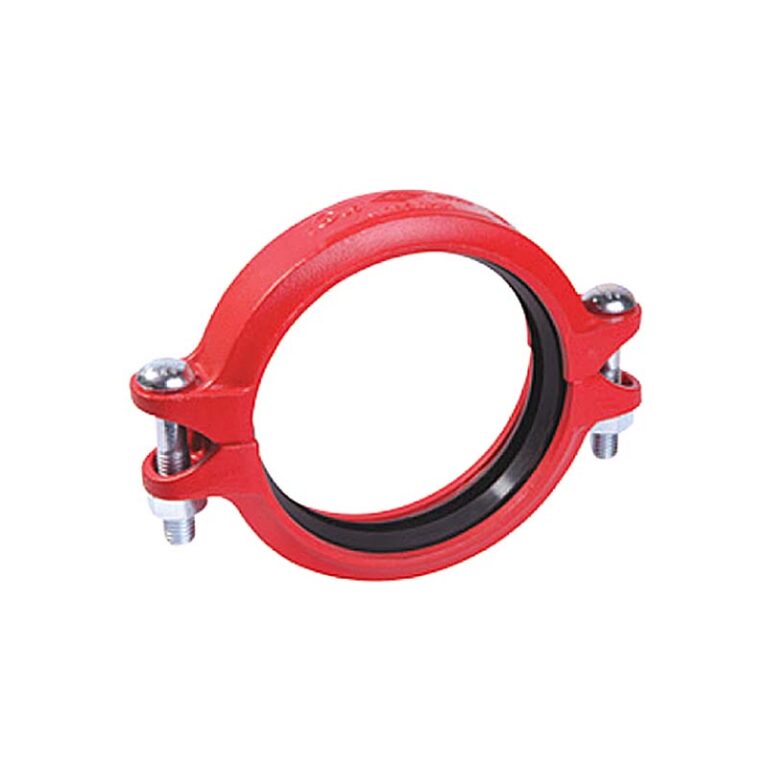
Drawings give sizes as nominal diameter (DN), sites order them in inches, and grooved fittings and flanges are made to the pipe’s actual outside diameter. This table brings the three together with Schedule 40 wall thickness, and explains the commonest cause of ordering mistakes: the same nominal size can come in more than one outside diameter.
Key points
- DN is a nominal number; the outside diameter is what sizes the coupling and grooved fitting.
- In the American standard the outside diameter is fixed for each size, and wall thickness varies with the schedule.
- Some sizes have a different outside diameter in metric pipe, so order fittings by outside diameter, not just by inch size.
- For quick conversion use the size converter.
DN, inch and outside diameter: the difference
DN (Diamètre Nominal) is a nominal number roughly in millimetres, and the inch size (NPS) is its American equivalent. Both name the size; neither is a measurement. The outside diameter (OD) is the actual measurement, fixed for each size whatever the wall thickness, which is why couplings, fittings and flanges are made to it.
The full chart
| Nominal diameter | Inch | OD (mm) | OD (in) | Sch 40 wall (mm) |
|---|---|---|---|---|
| DN15 | 1/2″ | 21.3 | 0.840 | 2.77 |
| DN20 | 3/4″ | 26.7 | 1.050 | 2.87 |
| DN25 | 1″ | 33.4 | 1.315 | 3.38 |
| DN32 | 1-1/4″ | 42.2 | 1.660 | 3.56 |
| DN40 | 1-1/2″ | 48.3 | 1.900 | 3.68 |
| DN50 | 2″ | 60.3 | 2.375 | 3.91 |
| DN65 | 2-1/2″ | 73.0 | 2.875 | 5.16 |
| DN80 | 3″ | 88.9 | 3.500 | 5.49 |
| DN100 | 4″ | 114.3 | 4.500 | 6.02 |
| DN125 | 5″ | 141.3 | 5.563 | 6.55 |
| DN150 | 6″ | 168.3 | 6.625 | 7.11 |
| DN200 | 8″ | 219.1 | 8.625 | 8.18 |
| DN250 | 10″ | 273.0 | 10.750 | 9.27 |
| DN300 | 12″ | 323.8 | 12.750 | 10.31 |
| DN350 | 14″ | 355.6 | 14.000 | 11.13 |
| DN400 | 16″ | 406.4 | 16.000 | 12.70 |
| DN450 | 18″ | 457.0 | 18.000 | 14.27 |
| DN500 | 20″ | 508.0 | 20.000 | 15.09 |
| DN600 | 24″ | 610.0 | 24.000 | 17.48 |
Values are from the ASME B36.10M tables. Thinner-wall sprinkler pipe (such as Sch 10) has the same outside diameter; only the thickness differs.
The key warning: the same size, a different outside diameter
Warning
Pipe made to metric standards (European, for example) comes in some sizes with a different outside diameter from the American standard. A coupling designed for 114.3 mm will not fit a 108.0 mm pipe, even though both are “4 inch”. Measure the pipe’s outside diameter or read it from the mill certificate before ordering.
| Size | Nominal diameter | American OD (mm) | Other ODs (mm) |
|---|---|---|---|
| 2-1/2″ | DN65 | 73.0 | 76.1 |
| 4″ | DN100 | 114.3 | 108.0 |
| 5″ | DN125 | 141.3 | 139.7 / 133 |
| 6″ | DN150 | 168.3 | 165.1 / 159.0 |
The table for the 1N flexible coupling gives the working pressure, end load and approvals for each outside diameter. They differ between diameters, so use the correct row.
Ordering grooved fittings correctly
- Establish the nominal size and the pipe’s actual outside diameter.
- Establish the wall thickness and grooving method (roll or cut). See the difference between them.
- Choose a model whose table covers that outside diameter, and check the working pressure for that row.
- Write both the size and the outside diameter on the order, for example: 4″ (114.3 mm).
Frequently asked questions
Is DN100 exactly 100 mm?
No. DN100 names the size; its outside diameter in the American standard is 114.3 mm, and its inside diameter depends on the wall thickness.
Does the outside diameter change between Sch 10 and Sch 40?
No. The outside diameter is the same; the thickness and inside diameter change.
How do I find the outside diameter of a pipe on site?
Measure the circumference with a tape and divide by 3.1416, or read it from the mill certificate or the marking printed on the pipe.
References
- ASME B36.10M — Welded and Seamless Wrought Steel Pipe.
- ASTM F1476 — Performance of Gasketed Mechanical Couplings for Use in Piping Applications.
Values are for guidance; the final reference is the pipe certificate and the table of the model chosen.
Part of a complete guide
This article is part of The Complete Guide to Grooved Piping Systems: How They Work, Selection, Installation and Inspection.