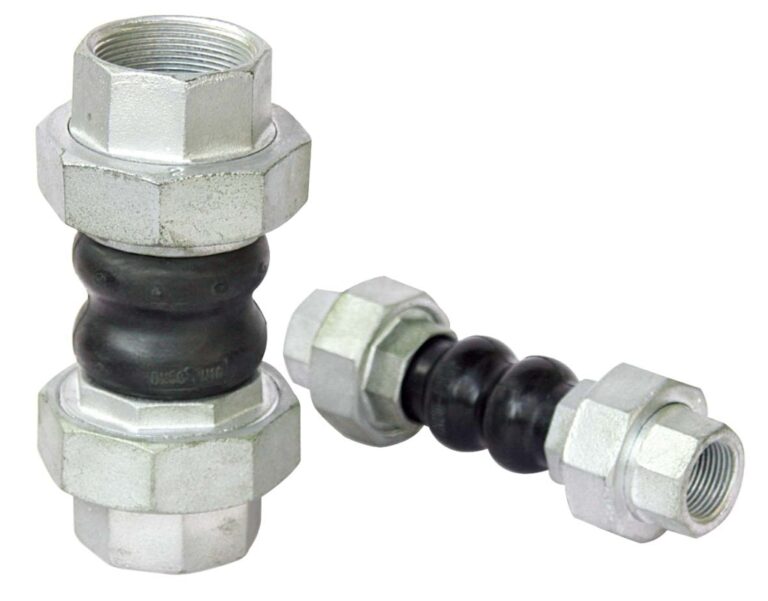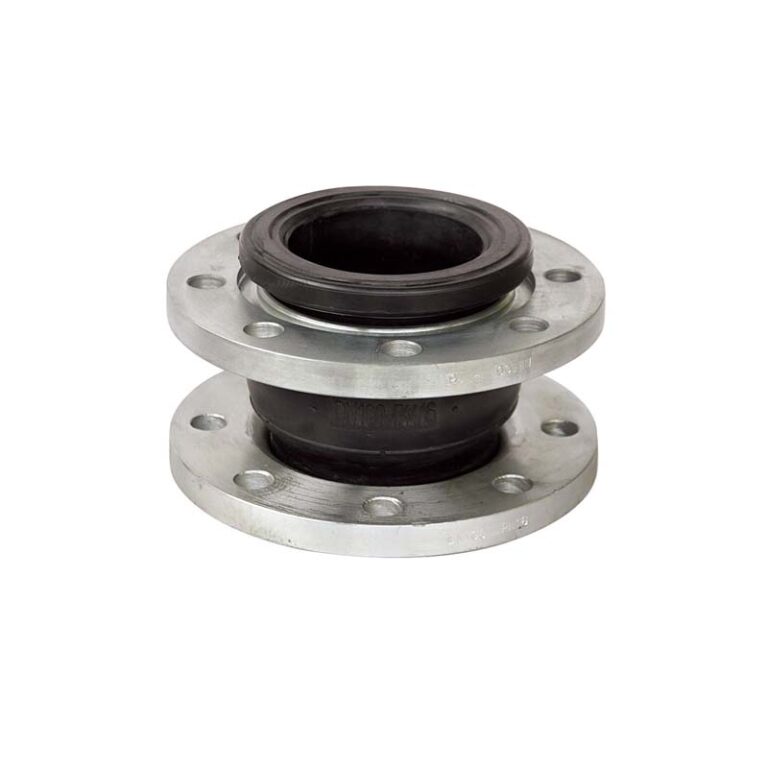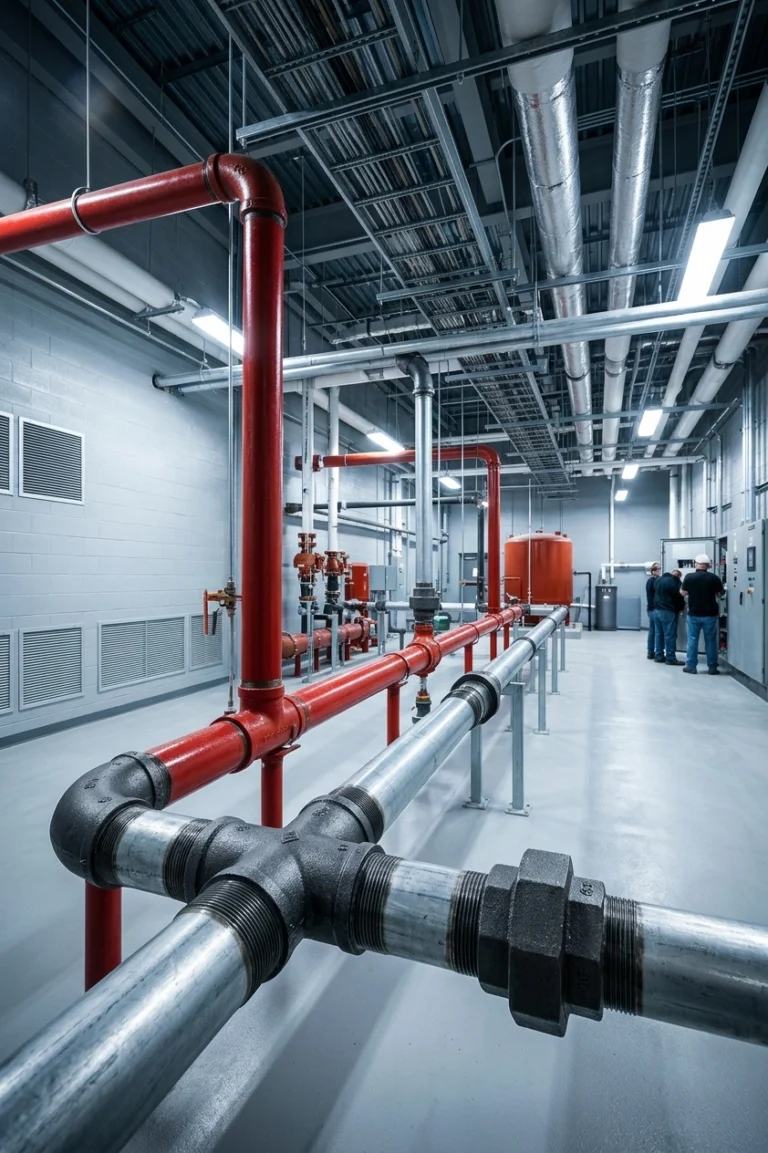
A flexible rubber joint is a short fitting with a reinforced rubber body, installed between equipment and pipework to absorb vibration, noise and small movements. It is most used at pumps, chillers and air-conditioning plant, where vibration travels easily through pipes into the building. This guide explains when you need one, how to install it correctly, and the MECH model specifications.
Key points
- Isolates vibration and noise, and absorbs small movements and misalignment.
- It does not carry pipe weight: pipes on both sides must be supported independently.
- Never install it twisted, and do not use it to correct large misalignment.
- MECH models: flanged up to 24″, and threaded union up to 3″.
How does it work?
The rubber body, reinforced with fabric layers, is usually shaped as a sphere or arch, allowing limited axial, lateral and angular movement. Vibration from the equipment is absorbed in the rubber instead of passing along the steel pipe.
Where is it used?
- On pump suction and discharge lines.
- At chillers and rotating equipment.
- Between equipment and pipework in noise-sensitive buildings.
- To accommodate small movement or limited settlement between equipment and system.
MECH models
| Model | Connection | Sizes | Working pressure | Vacuum |
|---|---|---|---|---|
| XTQ1RF | Flanges drilled ASME B16.5 CL150 | 1-1/4″ – 24″ | 300 PSI | 700 mmHg |
| XTQ2L | Threaded union ASME B1.20.1 | 1/2″ – 3″ | 300 PSI (200 / 250 on request) | 500 mmHg |
The vacuum rating matters on suction lines, where pressure can fall below atmospheric; the joint must withstand this without collapsing.
Correct installation
- Support the pipes on both sides with independent supports; the joint is not a hanger.
- Install the joint without twist, and align the flanges before tightening.
- Tighten flange bolts gradually and alternately as the data sheet instructs, and re-check them after first operation.
- At high pressure or without adequate anchoring, control rods may be needed to limit extension; the designer and the manufacturer’s data set them.
- Do not paint the rubber body, and protect it from excess heat, oils and direct sunlight.
Caution
A flexible joint is not a fix for large misalignment between equipment and pipe. Forcing it over a large offset strains the rubber, shortens its life and can make it fail under pressure.
How it differs from a flexible grooved coupling
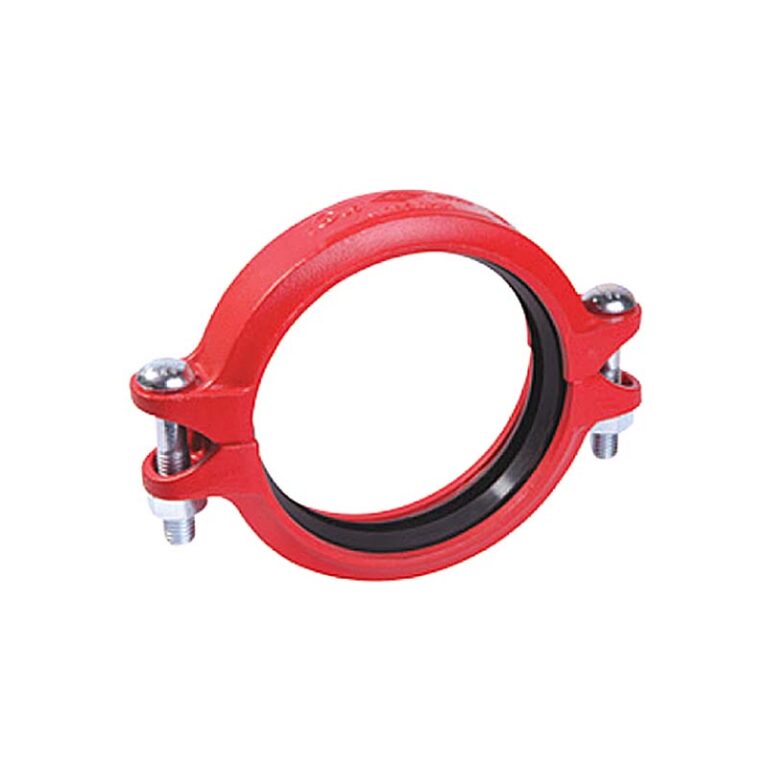
A flexible grooved coupling allows limited angular deflection and axial movement between two grooved pipes, but it does not isolate vibration as effectively as a rubber body. At pumps both may be used together, as the design requires.
Frequently asked questions
Can a rubber joint be used in a fire system?
Fittings in fire systems must be listed and approved for the use. No UL / FM approval is stated for the MECH models here, so refer to the consultant and the project specification.
How much movement can the joint take?
Axial, lateral and angular movement limits vary by size and come from the manufacturer’s data sheet.
When should the joint be replaced?
When cracks, abnormal bulging or hardening of the rubber appear during routine equipment inspection.
References
- ASME B16.5 — Pipe Flanges and Flanged Fittings.
- ASME B1.20.1 — Pipe Threads, General Purpose (Inch).
- MECH data for models XTQ1RF and XTQ2L on the product pages below.
This guide is for technical awareness and does not replace the manufacturer’s data sheet or the requirements of the project’s approved designer.